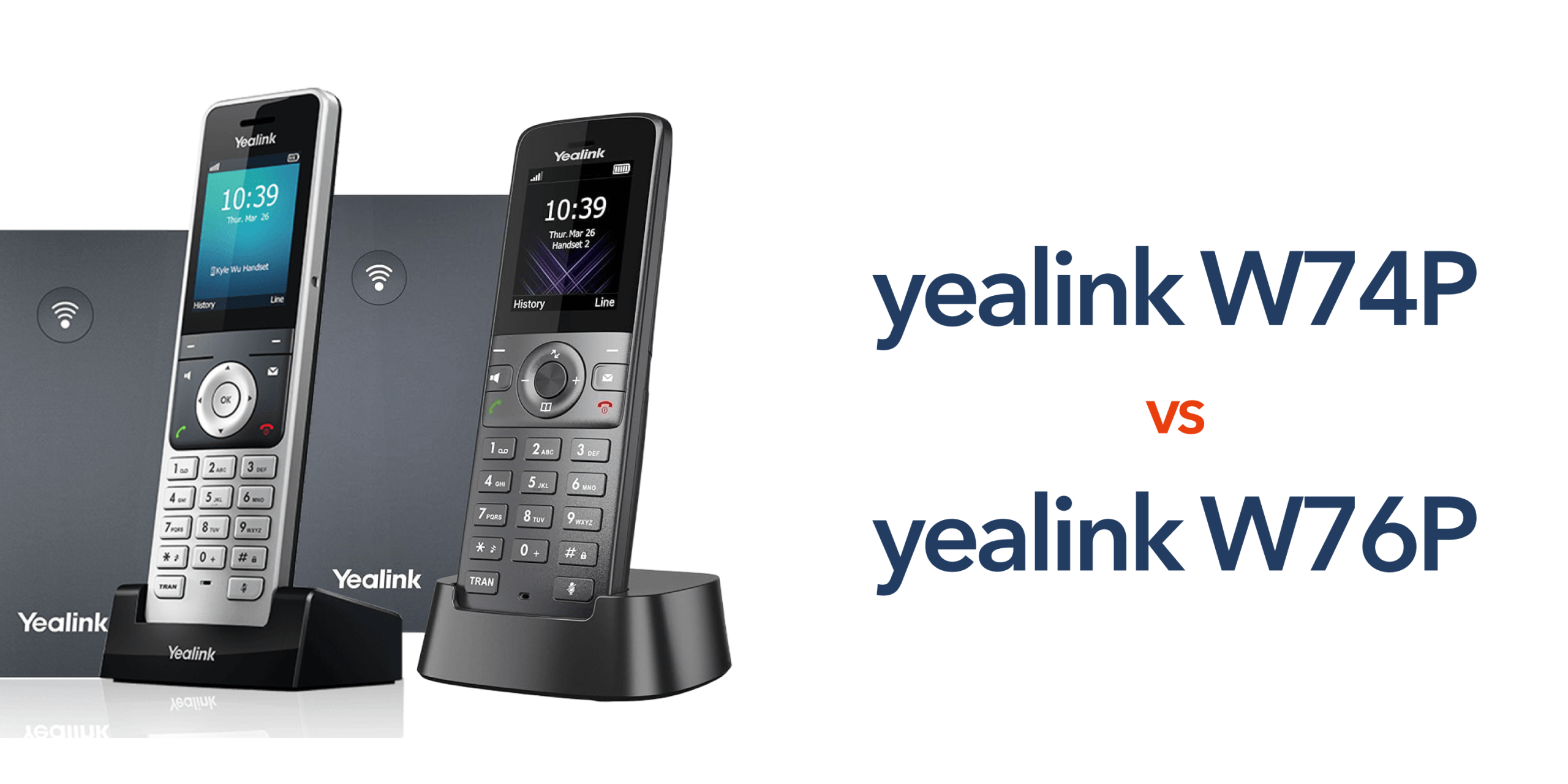
When comparing Yealink W74P vs W76P, the decision goes beyond basic handset features. It is about choosing a wireless VoIP phone system that supports how your business communicates, adapts to growth and maintains reliability across daily operations.
For UK businesses moving from PSTN to VoIP, DECT systems continue to offer a practical and dependable solution. They provide the mobility required for dynamic work environments, the flexibility to scale with your team, and the consistent call quality expected from modern business telecoms. Both the Yealink W74P and W76P are part of Yealink’s professional DECT portfolio, yet each is designed with slightly different business priorities in mind.
Understanding the differences between Yealink W74P and W76P helps ensure you select a system that aligns with your operational needs, whether that is cost efficiency, user experience or long-term scalability.
This guide clearly explains those differences so you can make a confident and commercially sound decision.
Yealink W74P vs W76P: Core Differences
When comparing Yealink W74P vs W76P, both systems share the same core DECT base capabilities, including support for up to 10 handsets and 20 simultaneous calls. The main differences come down to handset design, usability and overall user experience rather than performance or scalability. Let’s take a detailed look at the differences.
Hardware and Design
When comparing Yealink W74P vs W76P, both systems are built on Yealink’s professional DECT platform, offering robust base stations, strong signal coverage and support for up to 10 handsets. However, the key difference lies in the handset design and overall user experience rather than core system capability.
Yealink W74P
The Yealink W74P is an entry-level professional DECT system designed for reliability and simplicity. It offers a standard handset that performs consistently in everyday business environments. This makes it well-suited for organisations that need dependable communication without advanced features.
- Entry-level professional DECT system
- Standard handset with reliable performance
- Designed for straightforward business use
Yealink W76P
The Yealink W76P is a more premium DECT system, featuring an upgraded handset with improved build quality. It includes enhanced ergonomics and a colour display, making it easier and more comfortable for frequent use. The improved interface supports faster navigation and better usability.
- Premium DECT system with upgraded handset
- Enhanced ergonomics and build quality
- Colour display and improved user interface
What this means for your business:
When comparing Yealink W74P vs W76P, the key difference lies in user experience. The W76P is ideal for teams that spend long hours on calls and need a more refined device. The W74P, however, remains a cost-effective and reliable choice for standard business communication needs.
Performance and Capacity
Both systems share the same DECT base station capabilities, supporting up to 10 handsets and handling up to 20 simultaneous calls with reliable coverage across typical office environments. They also integrate seamlessly with cloud telephony platforms, making them suitable for modern VoIP deployments. When comparing Yealink W74P and W76P, performance at the system level is largely identical, with the key difference being the handset experience rather than overall capacity.
Audio Quality and User Experience
The Yealink W74P delivers reliable HD voice quality, making it well-suited for standard business calls where consistency and clarity are essential. Its functional interface ensures ease of use without unnecessary complexity, supporting everyday communication needs across SMEs and office teams.
The Yealink W76P, however, enhances the overall experience with improved HD audio, offering better speaker and microphone clarity. It also features more intuitive navigation, allowing users to handle calls more efficiently, especially in fast-paced environments.
From a commercial perspective, when comparing Yealink W74P vs W76P, these differences can directly impact customer interactions. For sectors such as retail, accountancy and service-based businesses, clearer calls and smoother usability can contribute to a more professional and responsive customer experience.
Features and Functionality
Both models support modern VoIP phone systems, offering reliable wireless connectivity across office environments along with seamless integration into business broadband and cloud telephony platforms. They also include secure communication protocols, ensuring safe and stable business communications.
When comparing Yealink W74P vs W76P, the core functionality remains consistent across both systems, making them equally suitable for most VoIP deployments. However, the W76P introduces a more refined user experience with faster interaction, improved display visibility and slightly more advanced usability features.
These enhancements make the W76P better suited for businesses where efficiency and ease of use are a priority, while the W74P continues to deliver dependable performance for standard operational needs.
Use Cases: Which Model Fits Your Business?
When comparing Yealink W74P vs W76P, the right choice depends on how your teams communicate and operate day to day. Let’s take a look at which model aligns best with different business environments and usage needs.
When to Choose Yealink W74P
The W74P is ideal for:
- SMEs with moderate call volumes
- Back-office teams
- Warehouses or logistics environments
- Businesses prioritising cost efficiency
It delivers dependable VoIP functionality without unnecessary complexity.
When to Choose Yealink W76P
The W76P is better suited for:
- Customer-facing teams
- Multi-site organisations
- High call volume environments
- Businesses prioritising user experience and efficiency
It is particularly effective where staff rely on wireless phones throughout the working day.
How This Fits into Your VoIP Strategy
With the UK PSTN switch-off approaching, businesses must adopt VoIP-based communication systems. DECT solutions like the W74P and W76P provide a bridge between traditional telephony and modern cloud-based systems. Both models integrate seamlessly with cloud telephony platforms, business internet and broadband services, and scalable business phone systems. The decision is less about technology capability and more about how your team interacts with that technology daily.
Commercial Considerations
When comparing Yealink W74P vs W76P, businesses should evaluate factors such as total cost versus long-term usability, staff productivity, ease of use and the overall impact on customer experience. It is also important to consider how each system fits within your wider telecoms setup and future scalability. The W74P delivers excellent value for money, while the W76P provides enhanced usability that can justify the additional investment in environments where performance and user experience are critical.
Making the Right Choice for Your Business
The choice between Yealink W74P and W76P comes down to how your business communicates. If you need a reliable, cost-effective DECT system, the W74P is a strong option. If your teams depend heavily on call handling and user experience, the W76P provides a more refined solution. At circle.cloud, we help UK businesses align their telecoms systems with real operational needs, ensuring performance, scalability and long-term value.
FAQs:
Is there a difference in call quality between W74P and W76P?
Both provide HD audio, but the W76P delivers slightly enhanced clarity due to improved handset design.
Can both systems support multiple locations?
Yes, when integrated with cloud telephony, both can support multi-site operations.
Are these suitable for VoIP migration from PSTN?
Yes. Both are designed for VoIP environments and are ideal for businesses transitioning away from traditional telephone networks.
Which is better for small businesses?
The W74P is typically more cost-effective for smaller teams with standard communication needs.