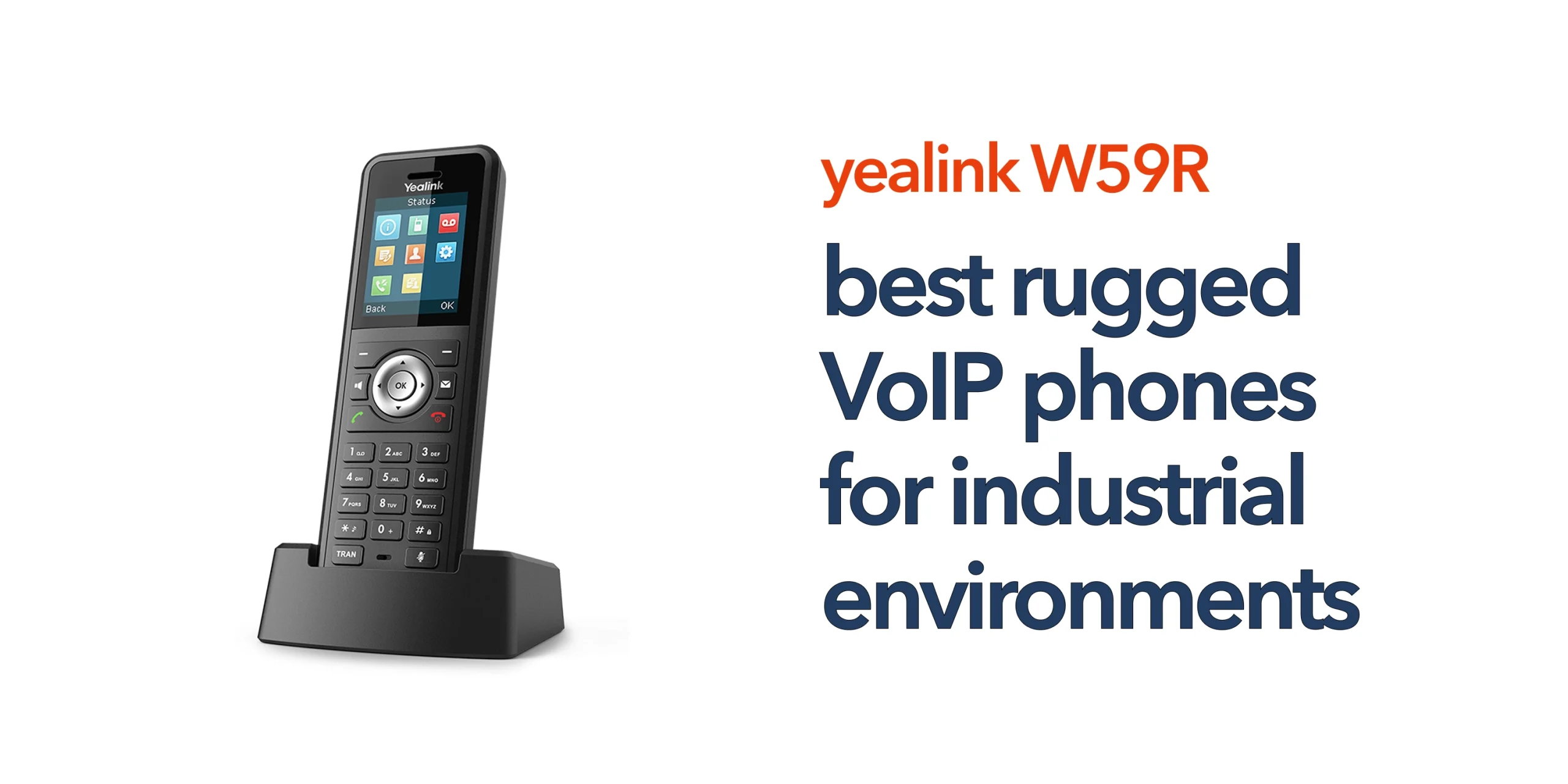
Many standard VoIP phones are built for desk-based use, not for the realities of industrial environments. In warehouses, construction sites, healthcare facilities, and large venues, devices are exposed to dust, moisture, drops, and constant movement. Over time, this leads to damaged handsets, inconsistent call quality, and unnecessary disruption to daily operations. For businesses operating in these conditions, the handset is just as important as the wider VoIP phone system. Choosing the wrong device can result in higher replacement costs, reduced staff mobility, and communication breakdowns across your site.
The Yealink W59R is designed specifically to address these challenges. As a rugged DECT handset, it combines durability, reliable wireless communication, and safety-focused features, making it well-suited to demanding environments where standard devices struggle to perform.
Understanding how the W59R compares to other rugged and non-rugged VoIP options helps ensure your communication system supports productivity, reliability, and long-term growth, rather than holding your business back.
What Makes a VoIP Phone Suitable for Industrial Use?
Not all VoIP phone systems are designed for industrial environments. In these settings, the handset itself plays a critical role in ensuring consistent and reliable communication. Standard devices often struggle to cope with physical demands, leading to failures and disruption. A suitable rugged VoIP phone should provide:
- Strong durability to withstand impact, dust, and water exposure
- Reliable wireless communication across large or complex sites
- Long battery life to support shift-based operations
- True mobility without compromising call quality
This is where the Yealink W59R stands out. It is purpose-built for high-movement and demanding environments, delivering the reliability and resilience needed for day-to-day operations.
Key Rugged VoIP Phone Options for Industrial Environments
There are several types of VoIP handsets used in industrial environments, each suited to different operational needs. Understanding these options helps you identify where rugged devices like the Yealink W59R provide the most value.
Yealink W59R
The Yealink W59R is a rugged DECT handset designed for demanding business environments where reliability and durability are critical. It is built to perform in conditions where standard devices are likely to fail.
- IP67-rated for dust and water resistance
- Shock-resistant to withstand drops and impacts
- DECT-based wireless communication for stable and consistent connectivity
- Built-in safety features, including an alarm button and man-down detection
It is best suited to environments such as warehouses, healthcare facilities, hospitality venues, and industrial sites, where staff need to stay connected while moving across large or physically demanding areas.
Standard DECT Handsets (Non-Rugged)
Standard DECT handsets are widely used in office environments where conditions are controlled, and the risk of damage is low. They are typically lightweight, cost-effective, and designed for desk-based or low-mobility use. However, they offer limited protection against drops, dust, or moisture.
In industrial or high-movement environments, this becomes a clear limitation. These devices are more likely to fail under physical stress, leading to increased replacement costs and potential disruption to day-to-day communication.
Wi-Fi VoIP Phones
Wi-Fi-based VoIP phones are another option, particularly in environments with strong and consistent wireless coverage. They use existing Wi-Fi networks, support app-based communication, and offer flexible deployment without additional base station infrastructure.
However, their performance is directly tied to network quality. In large, busy, or complex industrial sites, Wi-Fi coverage can be inconsistent, which may result in poor call quality, latency, or dropped connections.
Smartphone-Based VoIP Solutions
Some businesses use smartphones with VoIP apps as an alternative to dedicated handsets. They offer a familiar interface, support multiple functions beyond calling, and can be deployed quickly without additional hardware.
However, standard smartphones are not built for industrial environments. They lack durability and are more vulnerable to damage, often requiring extra protective cases or replacements, which can increase long-term costs and risk of downtime.
Where the Yealink W59R Stands Out
The Yealink W59R is designed to address the limitations of standard VoIP devices in demanding environments. Its combination of durability, reliable connectivity, and safety features makes it a practical choice for businesses that rely on consistent communication in challenging conditions.
- Built for Harsh Environments – The Yealink W59R is designed for conditions where standard devices struggle to perform. Its rugged construction ensures reliable operation in environments exposed to dust, moisture, impact, and constant movement.
- Reliable Communication Without Wi-Fi Dependency – Using digital enhanced cordless telecommunications (DECT) technology, the W59R delivers stable and consistent communication without relying on Wi-Fi. This makes it particularly effective across large or complex sites where wireless coverage may vary.
- Safety-Focused Features – Unlike most alternatives, the W59R includes built-in safety features such as emergency alarm functions and man-down detection, helping protect staff in higher-risk or lone working environments.
- Seamless Integration with Modern Telecoms – The W59R integrates with modern cloud telephony and VoIP phone systems, supporting businesses as they move away from the public switched telephone network (PSTN) towards more flexible and scalable communication solutions.
Why the Yealink W59R Is Often the Practical Choice
When comparing rugged VoIP options, the Yealink W59R stands out by offering a practical balance of durability, mobility, and seamless integration with modern telecom systems. It is designed to address common challenges such as device failure in demanding environments, unreliable communication across large sites, limited staff mobility, and the lack of safety features found in standard handsets.
For many businesses, this makes it a straightforward choice. It not only supports day-to-day operations but also aligns with modern VoIP and cloud telephony infrastructure, ensuring reliability both now and as the business grows.
Choosing the Right Device for Your Environment
Selecting a VoIP handset depends on how and where your teams work. Different environments place different demands on communication devices, so choosing the right fit is essential for reliability and efficiency. The right handset depends on how your business operates day to day and the conditions your teams work in:
- Office-based environments: Standard DECT handsets are typically sufficient for desk-based teams in controlled settings
- Mixed environments: A combination of devices may be required to support both office staff and mobile teams
- Industrial or high-movement environments: Rugged devices like the Yealink W59R are essential for durability, mobility, and reliable communication
Aligning your handset choice with your working environment helps ensure consistent performance, reduced downtime, and better long-term value.
Conclusion
Choosing the right VoIP handset is about ensuring your communication system works in real-world conditions. The Yealink W59R is designed for businesses that need reliability beyond the office. At circle.cloud, we help UK businesses deploy simple, reliable communication systems built around how their teams actually work. If you are evaluating rugged VoIP options, we can help you choose the right setup for your environment.
FAQs
Is the Yealink W59R better than a standard VoIP phone?
In demanding environments, yes. It is specifically designed for durability and mobility, which standard phones cannot match.
Does the Yealink W59R require Wi-Fi?
No. It uses DECT technology, which provides stable communication independent of Wi-Fi networks.
Can the W59R be used with cloud phone systems?
Yes. It integrates with modern VoIP and cloud telephony platforms.
Is the Yealink W59R suitable for SMEs?
Yes. It is particularly useful for SMEs operating in logistics, healthcare, or multi-site environments.