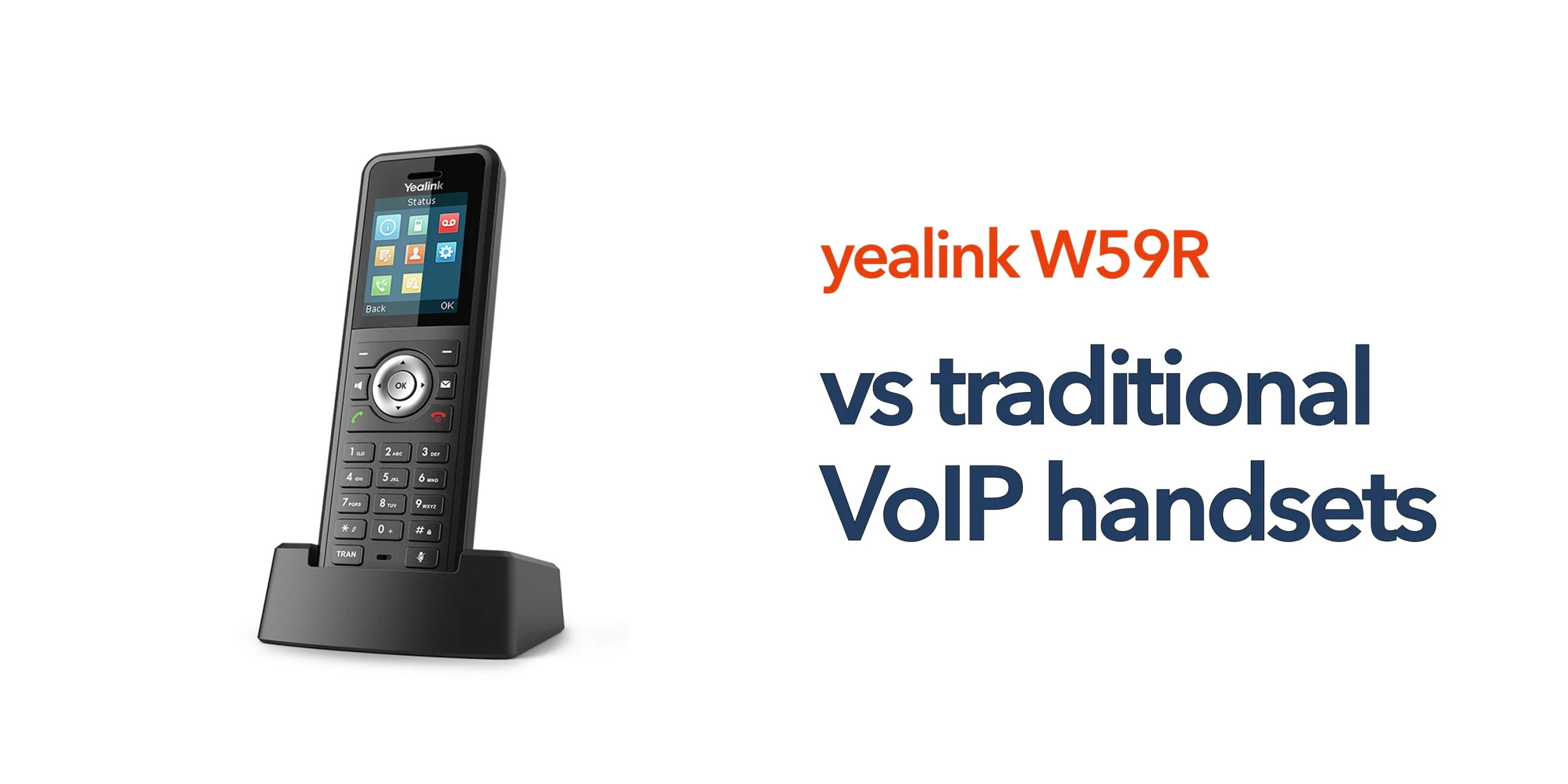
Choosing between a Yealink W59R and traditional VoIP handsets is not simply a matter of comparing features. It is about understanding how your team works and how communication supports your day-to-day operations.
The Yealink W59R is a wireless DECT handset designed for mobility, making it well-suited to environments where staff need to move freely while staying connected. In contrast, traditional VoIP handsets are desk-based devices built for fixed workstations, offering structured call handling and consistency in office settings. Both operate using voice over internet protocol and integrate with modern cloud telephony platforms, but they are designed to solve very different operational challenges.
For UK businesses, the decision often comes down to balancing mobility, reliability, and ease of use within a wider business telecoms setup. Understanding these differences ensures you choose a solution that supports productivity, rather than limiting how your team communicates.
What Is the Yealink W59R?
The Yealink W59R is a rugged wireless phone built using digital enhanced cordless telecommunications technology. It is designed for environments where mobility, durability, and flexibility are essential. The key characteristics include:
- Wireless DECT connectivity
- Rugged design (dust and water resistant)
- Long battery life for extended use
- Seamless integration with VoIP phone systems
This makes it well-suited to businesses that require communication beyond a desk.
What Are Traditional VoIP Handsets?
Traditional VoIP handsets are desk-based phones that connect directly to your network via Ethernet or Wi-Fi. They are commonly used in office environments where users remain at a fixed workstation. Their key characteristics include:
- Fixed desk-based operation
- High call quality and stability
- Advanced call handling features
- Easy integration with business phone systems
They are ideal for structured communication environments.
Key Differences: Yealink W59R vs Traditional VoIP Handsets
To make the right choice, it helps to break down how each option performs in real working environments. The differences are not just technical, but practical in how your team communicates. Looking at these areas side by side makes the decision clearer.
Mobility vs Fixed Use
The most significant difference is mobility. The Yealink W59R allows staff to move freely across a site while staying connected, which is essential in fast-paced or large environments. Traditional VoIP handsets are tied to a desk, making them better suited to fixed roles where movement is limited and communication is more structured.
Environment Suitability
The W59R is designed for demanding environments such as warehouses, retail floors, and industrial sites where durability and flexibility are required. Traditional VoIP phones are better suited to office environments where conditions are controlled and predictable, and devices remain stationary.
Installation and Deployment
Traditional VoIP handsets typically require network cabling or reliable Wi-Fi at each desk, which can increase setup complexity across larger spaces. The W59R operates through a DECT base station, allowing wider coverage with fewer infrastructure requirements and making it easier to deploy across multiple areas.
Durability and Reliability
The rugged design of the W59R helps reduce the risk of damage in high-impact or challenging environments. It is built to handle drops, dust, and exposure to harsher conditions. Standard VoIP desk phones are not designed for this level of durability and are better suited to low-risk office settings.
Call Handling and Features
Traditional VoIP handsets often include more advanced desk-based features such as programmable keys, larger displays, and enhanced call management options. The W59R focuses on essential communication and mobility, prioritising ease of use while on the move rather than offering extensive on-device controls.
Pros and Cons of Each Option
Looking at features alone does not always give a clear answer. Understanding the advantages and limitations of each option helps you match the device to your working environment. This makes it easier to choose a solution that supports both performance and usability.
Yealink W59R Advantages and Limitations
Let’s take a look at the advantages of the Yealink W59R and where it delivers the most value:
- Enables full mobility across your workplace, allowing staff to stay connected while on the move
- Designed for tough environments, with a rugged build suited to demanding conditions
- Supports flexible and hybrid working, making it ideal for modern business operations
- Easier to deploy across large areas using DECT technology, without complex cabling
However, there are some limitations to consider depending on how your business operates:
- Offers fewer advanced desk-based features compared to traditional VoIP handsets
- Requires a DECT base station to operate effectively
- May not be the best fit for fully desk-based teams with minimal mobility needs
Traditional VoIP Handset Advantages and Limitations
Let’s take a look at where traditional VoIP handsets perform best and the value they offer in office environments:
- Strong call handling features, including programmable keys and advanced controls
- Stable and consistent performance when used in fixed network environments
- Ideal for structured office settings where users work from dedicated desks
- Lower cost for basic setups, making them suitable for standard deployments
However, there are some limitations to consider depending on your operational needs:
- Limited mobility, as devices are tied to a desk or a fixed location
- Not suitable for harsh or high-movement environments
- Requires fixed installation points, which can reduce flexibility in larger or dynamic workplaces
Which Option Is Right for Your Business?
The right choice between the Yealink W59R and traditional VoIP handsets depends on how your business operates. For retail and customer-facing businesses, the Yealink W59R is often the better option, as staff need to move freely while remaining reachable, improving both responsiveness and customer service. In warehousing and industrial environments, mobility and durability are essential, making the W59R the more practical choice due to its rugged design and wireless capability.
For office-based businesses, traditional VoIP handsets are usually sufficient, offering reliable communication and advanced call handling features for desk-based teams. Hybrid and multi-site organisations often benefit from a combination of both, using desk phones to support office staff while deploying W59R devices in areas where mobility is required.
Build a System That Works for Your Business
The decision between Yealink W59R vs traditional VoIP handsets should be based on how your business operates, not just device specifications. Factors such as where your employees work, how mobile they need to be, the environments they operate in, and how everything integrates with your cloud telephony system all play an important role. Modern business telecoms are built around flexibility and reliability. The right approach is often a mix of devices that support your workflow rather than limiting it. Choosing correctly ensures your communication system improves productivity and adapts as your business grows.
If you are upgrading your business phone systems or moving away from PSTN, now is the time to review your setup. Speak to our team to design a solution that fits your business needs.
FAQs
Is the Yealink W59R better than a traditional VoIP phone?
It depends on your environment. The W59R is better for mobility, while traditional VoIP phones are better for desk-based use.
Can you use both in the same system?
Yes, many businesses combine both devices within a single cloud telephony platform.
Do both support VoIP systems?
Yes, both are designed to work with VoIP phone systems and cloud-based platforms.
Is the W59R suitable for office use?
It can be used in offices, but it is most valuable in environments where mobility is required.