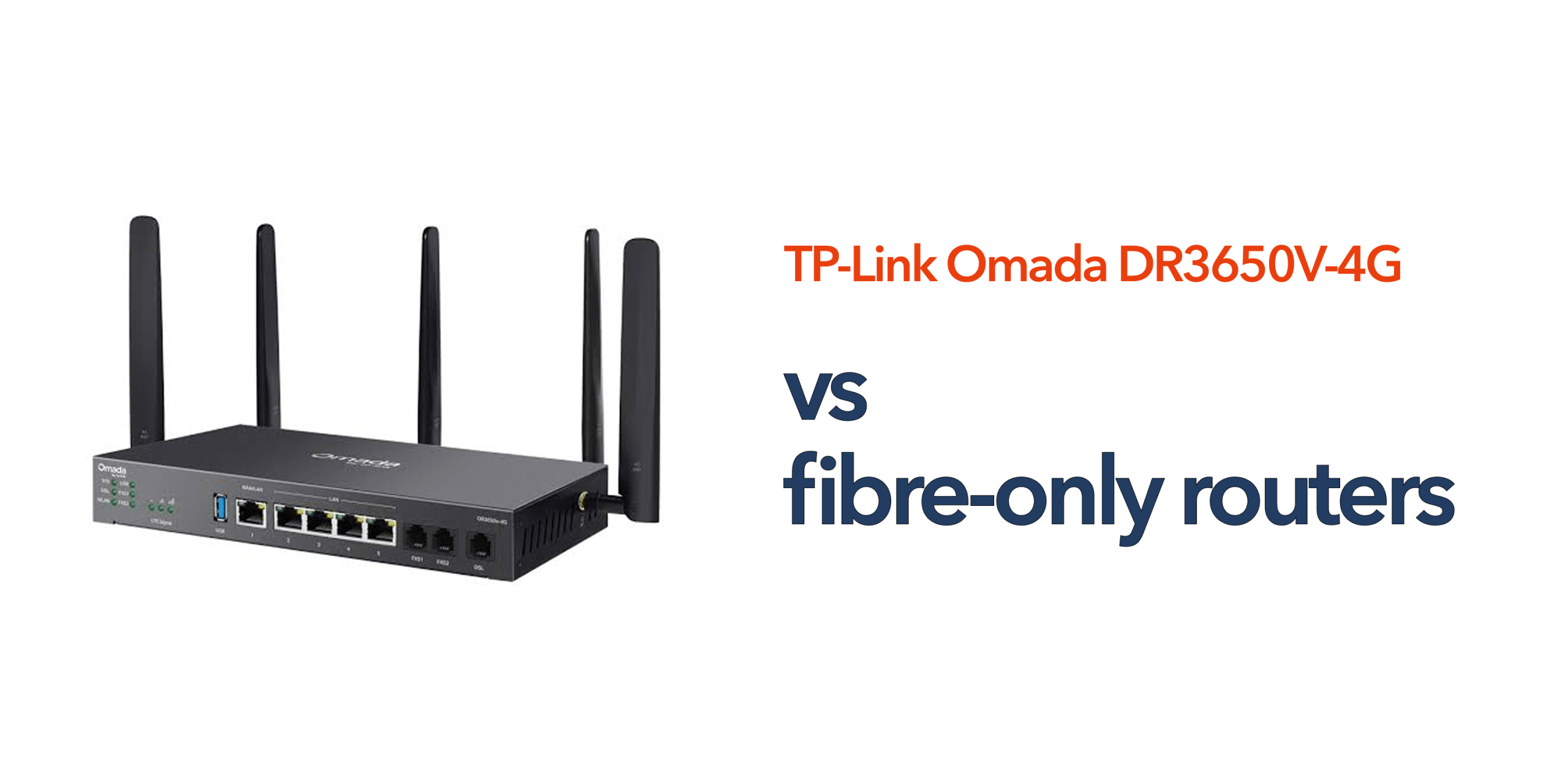
Modern businesses depend on reliable internet connectivity for almost everything they do. From VoIP phone systems and Microsoft 365 to cloud applications and customer service platforms, internet downtime can quickly disrupt operations. While fibre broadband delivers excellent speeds and performance, many businesses overlook one important risk. A fibre-only router still relies on a single internet connection. This is where the TP-Link Omada DR3650V-4G vs fibre-only routers comparison comes into play. The TP-Link Omada DR3650V-4G offers a different approach. By combining fibre connectivity with integrated 4G failover, it provides an additional layer of protection against unexpected outages.
Why Fibre-Only Routers Can Be a Business Risk
Fibre broadband is widely regarded as the gold standard for business connectivity. It offers fast download and upload speeds, low latency, reliable performance, and excellent support for cloud services. However, even the most reliable fibre service can experience disruption. Common causes include:
- ISP outages
- Network maintenance
- Local infrastructure faults
- Accidental cable damage
- Exchange issues
When a fibre-only router loses connectivity, the entire business can lose access to cloud phone systems, video meetings, CRM platforms, email services, and remote working tools. For many organisations, even a short outage can result in missed opportunities and reduced productivity.
What Makes the TP-Link Omada DR3650V-4G Different?
Note: the hardware specifications below (4G speed rating, Wi-Fi, FXS ports) should be verified against the current TP-Link datasheet before publishing, as they don’t appear in other content covering this model.
The TP-Link Omada DR3650V-4G is designed with resilience in mind. Unlike traditional fibre-only routers, it includes integrated 4G+ connectivity and dual Nano SIM support for automatic failover. If the primary internet connection becomes unavailable, traffic can automatically switch to the mobile network. The device also supports:
- 4G+ Cat 6 speeds up to 300Mbps
- Dual Nano SIM slots
- Load balancing across multiple WAN connections
- Wi-Fi 6 connectivity
- VPN support
- Centralised Omada cloud management
- VoIP compatibility through FXS ports
For businesses that rely on continuous connectivity, these features provide significantly more protection than a standard fibre-only router.
DR3650V-4G vs Fibre-Only Routers: Key Differences
At first glance, both the TP-Link Omada DR3650V-4G and a traditional fibre-only router provide internet connectivity for your business. However, the biggest difference lies in how they handle outages, network resilience, and business continuity. While fibre-only routers focus on delivering broadband connectivity through a single connection, the DR3650V-4G is designed to keep businesses online even when that primary connection fails.
Connectivity Resilience
A fibre-only router depends entirely on a single broadband service. If that connection goes down due to an ISP outage, network fault, or damaged infrastructure, internet access is lost until the issue is resolved.
The DR3650V-4G takes a more resilient approach by combining fibre, DSL, Ethernet WAN, and 4G connectivity within a single platform. This allows the router to automatically switch to a backup 4G connection if the primary broadband service becomes unavailable, helping businesses maintain internet access during unexpected outages.
Business Continuity
With a fibre-only router, internet disruptions often result in downtime while staff wait for the service provider to restore connectivity. During this period, access to cloud applications, VoIP phone systems, email, and collaboration tools may be interrupted.
The DR3650V-4G helps minimise these disruptions through integrated 4G failover. Because the backup connection activates automatically, many outages have little lasting impact on day-to-day operations. Employees can get back online quickly, customer communications can resume without lengthy delays, and critical cloud services remain reachable once the switch to 4G is complete.
Deployment Simplicity
Some businesses attempt to improve resilience by purchasing a separate 4G router and configuring a failover solution themselves. While effective, this can introduce additional hardware, management requirements, and complexity.
The DR3650V-4G simplifies deployment by combining broadband routing and 4G backup into a single device. This reduces the need for multiple pieces of equipment and makes network management easier for businesses with limited IT resources.
Remote Management
Traditional routers often require local access or separate management platforms, making it more difficult to monitor network performance across multiple locations.
The DR3650V-4G integrates with Omada Cloud SDN, allowing administrators to monitor, manage, and troubleshoot connectivity remotely. For businesses operating multiple sites or supporting remote workers, this centralised management capability provides greater visibility and control over the network.
When a Fibre-Only Router May Be Sufficient
Not every organisation requires a built-in 4G failover. A fibre-only router may be appropriate if:
- Internet downtime has minimal business impact
- The site is non-critical
- Backup connectivity already exists
- Cloud services are not heavily relied upon
For very small offices with limited internet dependency, a standard fibre router may provide adequate performance.
When the DR3650V-4G Becomes the Better Choice
The DR3650V-4G is particularly valuable for organisations where connectivity directly affects revenue, productivity, or customer service. This includes:
- Businesses Using Hosted VoIP: Cloud phone systems stop working when internet access is lost. Integrated 4G failover helps restore communication quickly during outages.
- Customer-Facing Organisations: Businesses that rely on inbound calls, online bookings, or cloud-based customer support systems benefit from faster recovery and less disruption.
- Multi-Site Businesses: Centralised management and resilient connectivity make deployment easier across multiple locations.
- Hybrid Work Environments: Remote teams often depend on cloud applications throughout the day. Maintaining access during broadband outages helps avoid disruption.
The Real Cost of Internet Downtime
Many organisations evaluate routers based solely on speed. In reality, resilience is often more important. A business losing internet access may experience missed customer calls, interrupted meetings, lost sales opportunities, reduced staff productivity, and delayed customer responses. The cost of even a short outage can easily exceed the investment in a router with built-in failover capabilities.
Is the TP-Link Omada DR3650V-4G Worth It?
For businesses that depend on cloud services, VoIP communications, and reliable internet access, the answer is often yes. While fibre-only routers provide excellent performance under normal conditions, they still represent a single point of failure. The TP-Link Omada DR3650V-4G adds an important layer of protection through integrated 4G failover, dual SIM support, load balancing, and centralised management. For organisations seeking reliable connectivity and business continuity, it offers a practical solution that goes beyond traditional fibre-only networking.
Speak to circle.cloud to find out whether the DR3650V-4G is the right connectivity solution for your business.
FAQs
Does the DR3650V-4G automatically switch to 4G during an outage? Yes. The router supports automatic 4G failover, helping maintain connectivity if the primary broadband connection fails.
Can the DR3650V-4G be used with fibre broadband? Yes. It supports Ethernet WAN connections and can work alongside fibre services while providing 4G backup.
Is 4G failover useful for VoIP phone systems? Absolutely. It helps get cloud phone systems back online quickly during broadband outages, reducing the risk of missed calls.
Does the DR3650V-4G support remote management? Yes. The router integrates with Omada Cloud SDN for centralised monitoring and management.
Who benefits most from the DR3650V-4G? SMEs, multi-site businesses, customer-facing organisations, and businesses that rely heavily on cloud applications and communications.