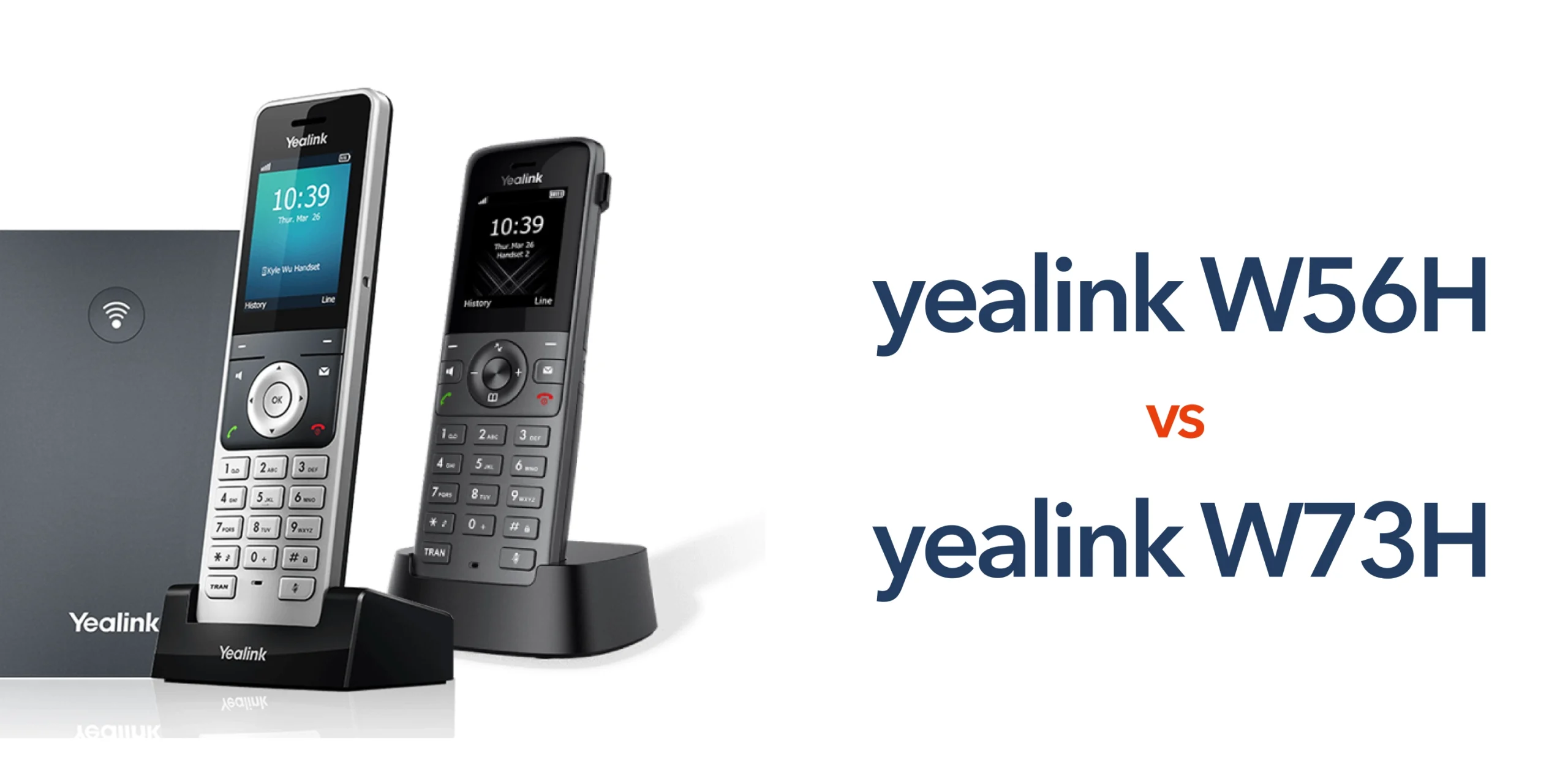
Many UK businesses are rethinking their communication systems as the PSTN switch-off approaches. Legacy phone lines are being phased out, and cloud telephony is quickly becoming the standard. For most organisations, moving to VoIP is no longer a future plan. It is a necessary step to maintain reliable, flexible business communications. However, while the shift to modern telecoms is clear, choosing the right hardware is often less straightforward.
This is where many businesses hesitate. The comparison between Yealink W56H vs W73H is one of the most common decisions faced when deploying a wireless DECT phone system. On the surface, both handsets offer reliable performance, HD voice, and compatibility with VoIP phone systems. But in practice, they are designed for slightly different environments and stages of business growth. Choosing the wrong device can lead to limitations later. Reduced mobility, shorter battery life, or outdated hardware can all impact how effectively your team communicates day to day.
Understanding the differences between these two Yealink handsets helps you make a more informed decision. It ensures your investment supports not just your current setup, but how your business operates as it grows and adapts to modern ways of working.
Key Differences Between Yealink W56H and W73H
Understanding the key differences between these two handsets helps move beyond basic specifications. It allows you to assess how each device performs in real working environments and which one better supports your day-to-day communication needs.
Design and Build
The Yealink W56H is a proven DECT handset built for everyday business use. It offers a durable design, straightforward interface, and consistent reliability, making it a dependable choice for office environments. The Yealink W73H introduces a more modern look with improved ergonomics and a refined user experience. While the W73H feels more contemporary, the W56H remains a practical and trusted option for businesses that prioritise simplicity and stability.
Performance and Responsiveness
The W73H benefits from newer hardware, resulting in faster navigation and smoother call handling. It is well-suited to environments with higher call volumes or more demanding usage. The W56H, while based on an earlier generation, still delivers reliable day-to-day performance. For many standard business environments, it provides more than enough responsiveness without unnecessary complexity.
Battery Life
Battery performance is an important factor for wireless handsets.
- W56H: Strong battery life that comfortably supports typical office usage
- W73H: Improved efficiency with extended talk and standby time
For desk-based or moderate mobility roles, the W56H performs reliably throughout the working day. The W73H becomes more beneficial in environments where devices are used continuously across longer shifts.
Audio Quality
Both handsets support HD voice, ensuring clear and professional call quality for business conversations. The W73H includes some enhancements in audio processing, which can improve clarity in busier environments. That said, the W56H still delivers consistently high-quality audio, making it well-suited to most office and customer communication needs.
Compatibility with Modern VoIP Systems
Both the W56H and W73H integrate with Yealink base stations and work with modern cloud telephony platforms. The W56H continues to perform reliably within established VoIP phone systems, making it a solid choice for businesses with stable setups. The W73H is designed with newer VoIP environments in mind, offering slightly better alignment with long-term, cloud-first telecom strategies.
Which Handset Is Right for Your Business?
Choosing between the two comes down to how your teams communicate day to day. The right handset should align with your working environment, mobility needs, and future telecom plans, not just feature comparisons.
- Office-Based Businesses: Both handsets perform reliably for desk-based teams such as accountants, consultants, and professional services. The Yealink W56H is a cost-effective and practical choice for stable environments with limited mobility. The W73H is better suited to businesses planning long-term telecom upgrades or modernisation.
- Retail and Customer-Facing Environments: Mobility is essential for staff working across shop floors, stock areas, and service points. The W73H offers better battery life and faster responsiveness for continuous use. The W56H can still perform well in smaller or less demanding retail settings.
- Multi-Site Organisations: Both devices support unified communication when used with a cloud phone system. The W56H provides reliable performance for established setups across locations. The W73H is more aligned with scalable, cloud-first VoIP deployments.
- Businesses Migrating from PSTN to VoIP: Moving away from the public switched telephone network requires future-ready hardware. The W56H remains a solid option for straightforward transitions with stable requirements. The W73H is better suited for businesses planning long-term, modern telecom infrastructure.
Use Case Comparison Summary
A simple way to decide is to match each handset to how your business operates. The right choice depends on your environment, usage levels, and how future-ready you want your telecom setup to be.
Choose Yealink W56H if:
- You need a proven, reliable handset
- Your environment is stable and office-based
- Budget is a key consideration
- You are not planning rapid expansion
Choose Yealink W73H if:
- You want a more modern device
- Your teams are mobile or customer-facing
- You are investing in long-term VoIP infrastructure
- You want better performance and battery life
Making the Right Decision for Your Telecom Setup
The decision between Yealink W56H vs W73H is not just about features. It is about choosing a handset that fits how your business communicates. Wireless DECT phones are part of a wider system that includes your VoIP phone system, business broadband, cloud telephony platform, and overall call setup. You only get full value when everything works together. A well-aligned system ensures reliable performance, clear call quality, and a better experience for your team and customers. Many businesses find that working with an experienced telecom provider like circle.cloud simplifies this process. If you are upgrading your communications or preparing for the PSTN switch-off, now is the right time to review your handset alongside your wider infrastructure.
FAQs
Is the Yealink W73H worth upgrading from the W56H?
Yes, especially if your business is moving to modern VoIP systems or requires better performance and battery life.
Do both handsets support cloud telephony?
Yes. Both devices work with cloud-based phone systems when paired with compatible base stations.
Which handset is better for retail environments?
The Yealink W73H is better suited due to improved battery life and responsiveness.
Can both devices be used in multi-site businesses?
Yes. When integrated with a VoIP phone system, both support communication across multiple locations.