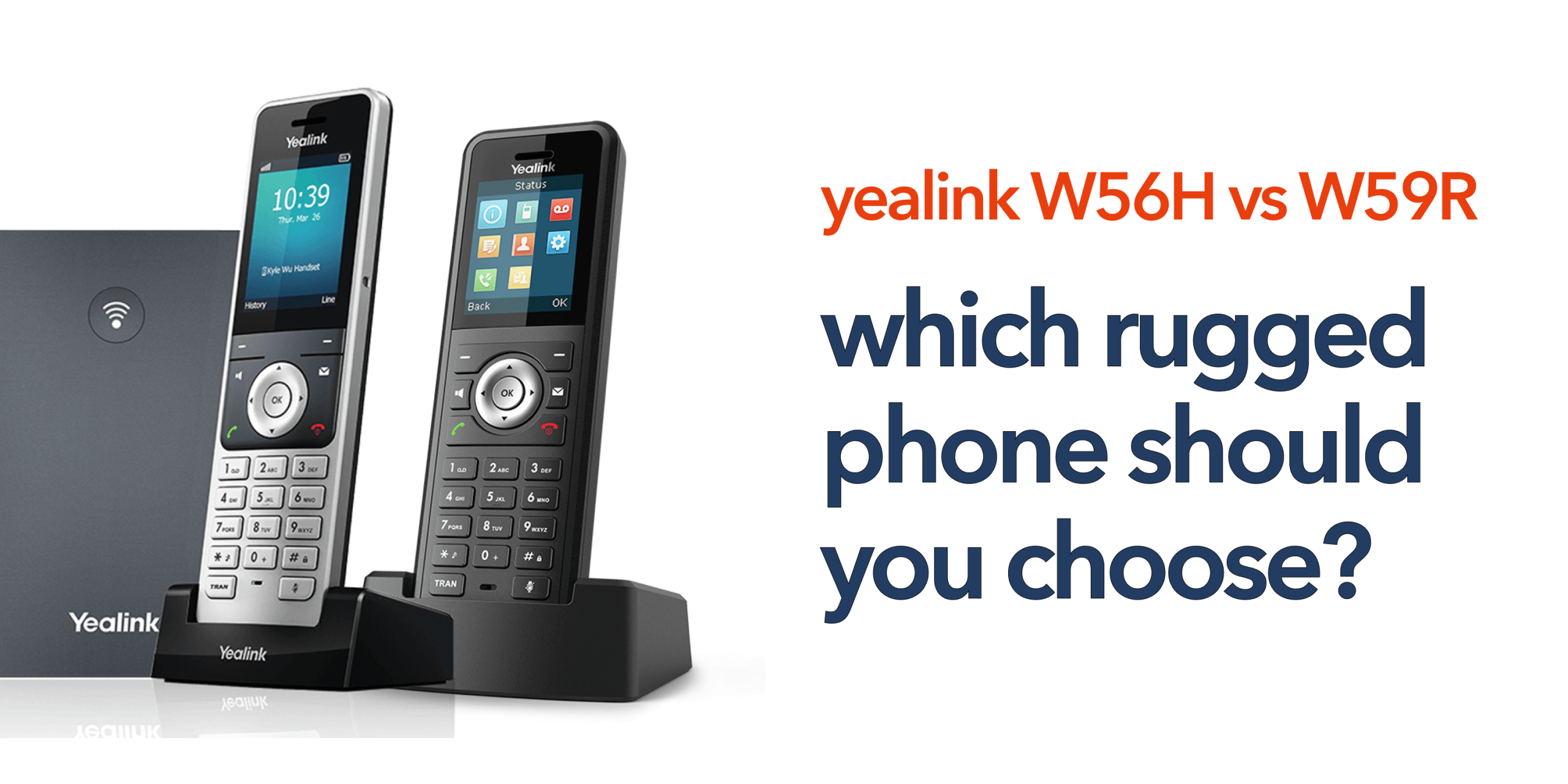
Choosing the right wireless handset is not just about features. It is about how your team operates in real working conditions. If you are comparing the Yealink W59R vs W56H, the decision comes down to one key factor: do you need a rugged handset or a standard office device? The Yealink W59R is specifically designed for demanding environments where durability, reliability, and staff mobility are critical. It is built to handle drops, dust, water exposure, and constant movement across large or complex sites. In contrast, the W56H is a lightweight, office-focused handset suited to desk-based or low-risk environments.
This is not just a technical difference. It directly impacts how your team communicates day to day. Choosing a non-rugged handset in a harsh environment can lead to device failures and disruption. Choosing a rugged handset when it is not needed can add unnecessary cost.
A clear understanding of how the W59R compares to the W56H helps ensure your business phone system supports productivity, reliability, and long-term value.
Understanding the Key Difference
At a basic level, both devices sit within Yealink’s DECT range and are designed for wireless VoIP communication as part of a modern business phone system. They both allow staff to move freely while staying connected, but they are built for very different environments. The key difference is straightforward:
- The W56H is a standard office handset designed for desk-based and low-impact environments
- The W59R is a rugged, industrial-grade handset built for durability, mobility, and harsher working conditions
This distinction goes beyond design. The Yealink W59R is engineered to handle real-world challenges such as drops, dust, and exposure to moisture, making it suitable for environments where a standard handset would struggle to last. In practical terms, this affects everything from reliability and lifespan to where and how the device can be used across your business.
Yealink W59R vs W56H Feature Comparison
To make the right choice, it is important to look beyond specifications and understand how each handset performs in real working environments. The differences between the W59R and W56H become clearer when you compare their features in practical terms.
Build and Durability
The Yealink W59R is built specifically for demanding, high-movement environments where standard handsets are likely to fail. It includes IP67-rated protection against dust and water, shock resistance for drops and impacts, and suitability for warehouses, construction sites, healthcare, and outdoor use.
The W56H, in contrast, is designed for office settings. It offers a lightweight and comfortable design but does not provide protection against physical damage or environmental exposure.
What this means for your business:
If your team operates in harsh or mobile environments, the W59R delivers the durability needed to maintain reliable communication without frequent device replacement or downtime.
Mobility and Working Environment
Both handsets use digital enhanced cordless telecommunications (DECT) technology, allowing staff to stay connected while moving around the workplace without relying on Wi-Fi.
However, the difference lies in how they handle real-world movement:
- The W59R is built for demanding mobility across large, busy, or complex environments
- The W56H is better suited to controlled office spaces with lighter day-to-day movement
Use case difference:
Retail floors, warehouses, healthcare settings, and multi-area sites benefit from the reliability and flexibility of the W59R. Office-based teams and professional services environments are typically better matched to the W56H.
User Experience and Design
The W56H is designed for simplicity and everyday usability in office environments. It offers:
- A clear, easy-to-read display
- A lightweight and comfortable design
- Ease of use for frequent call handling throughout the day
The W59R, on the other hand, is built with function as the priority. It features:
- A more robust, reinforced casing
- Dedicated emergency alarm capabilities
- A design focused on reliability in demanding conditions rather than aesthetics
What this means for your team:
If ease of use and comfort are the priority, the W56H fits naturally into office workflows. If reliability and resilience are more important, the W59R is the better choice.
Safety and Additional Features
One of the most important differences between the two devices is safety functionality.
The Yealink W59R is designed with worker safety in mind and includes a dedicated alarm button for emergency situations, man-down detection to alert if a user is immobile, and location tracking support when integrated with compatible systems.
The W56H does not include these safety features, as it is intended for standard office use rather than higher-risk environments.
Business impact:
If your teams work alone, across large sites, or in potentially hazardous conditions, the W59R adds an extra layer of protection that goes beyond basic communication.
Which Businesses Should Choose Each Model?
Choosing between the W59R and W56H depends on how and where your teams work day to day. The right handset should align with your environment, mobility needs, and any safety requirements.
When the Yealink W59R is the Better Choice
The Yealink W59R is the better choice for businesses operating in demanding or high-mobility environments, including:
- Warehousing and logistics operations
- Manufacturing and industrial sites
- Healthcare and care facilities
- Hospitality teams working across large venues
- Outdoor or higher-risk working conditions
In these environments, devices are exposed to movement, impact, and changing conditions. The W59R is built to handle this, ensuring communication remains reliable without frequent failures or downtime.
When the Yealink W56H is the Better Choice
The Yealink W56H is better suited for environments where durability is less of a concern and ease of use is the priority, including:
- Office-based businesses such as accountants and consultants
- Reception and administrative teams
- SMEs with standard day-to-day communication needs
- Businesses focused on cost efficiency
For these organisations, the added rugged features of the W59R are often unnecessary. A simpler, lighter handset like the W56H delivers reliable performance without additional cost or complexity.
How This Fits Into Your Wider Telecom Strategy
Choosing between the Yealink W59R vs W56H is not just about hardware. It should align with your overall business telecoms setup. Modern businesses are moving away from the public switched telephone network (PSTN) towards cloud telephony and voice over internet protocol (VoIP) systems.
Both devices integrate easily with cloud-based business phone systems, VoIP phone systems, and unified communications platforms. This means your handset choice should support mobility within your workplace, scalability as your business grows, and reliable connectivity via business broadband.
The Real Decision: Environment Over Features
The most important factor is not the feature list. It is where and how your team works. If your environment is controlled and office-based, the W56H offers simplicity and value. If your environment is unpredictable or physically demanding, the W59R delivers reliability and safety. Both devices provide strong call quality and integrate seamlessly into modern cloud-based business phone systems.
Common Mistakes to Avoid
When comparing the Yealink W59R vs W56H, businesses often choose based on price rather than how the device will be used. They also overlook the importance of durability in high-movement environments and ignore future scalability as teams or sites expand. They ultimately fail to align handsets with their wider VoIP and cloud telephony setup.
Avoiding these mistakes helps ensure your communication system is reliable, fit for purpose, and able to support your business as it grows.
Conclusion
Choosing the right handset is about more than comparing specifications. It is about selecting a device that fits how your team works and supports your communication system as your business grows. When comparing the Yealink W59R vs W56H, the decision comes down to environment. The W56H is well-suited to office-based teams that need simple, reliable communication. The W59R, however, is designed for demanding environments where durability, mobility, and safety are essential.
As many UK businesses move towards modern VoIP and cloud-based phone systems, selecting the right handset helps ensure consistent performance and long-term reliability. At circle.cloud, we help organisations choose and deploy communication solutions that are practical, scalable, and built around real-world use.
FAQs:
Is the Yealink W59R worth the higher cost?
Yes, if your business operates in demanding environments. The added durability and safety features justify the investment.
Can both phones be used with the same base station?
Yes. Both are compatible with Yealink DECT base stations and can be part of the same system.
Do both support VoIP phone systems?
Yes. Both devices are designed for use with modern VoIP and cloud telephony platforms.
Which is better for small businesses?
For most SMEs with office environments, the W56H is sufficient. The W59R is better for specialised or industrial use cases.