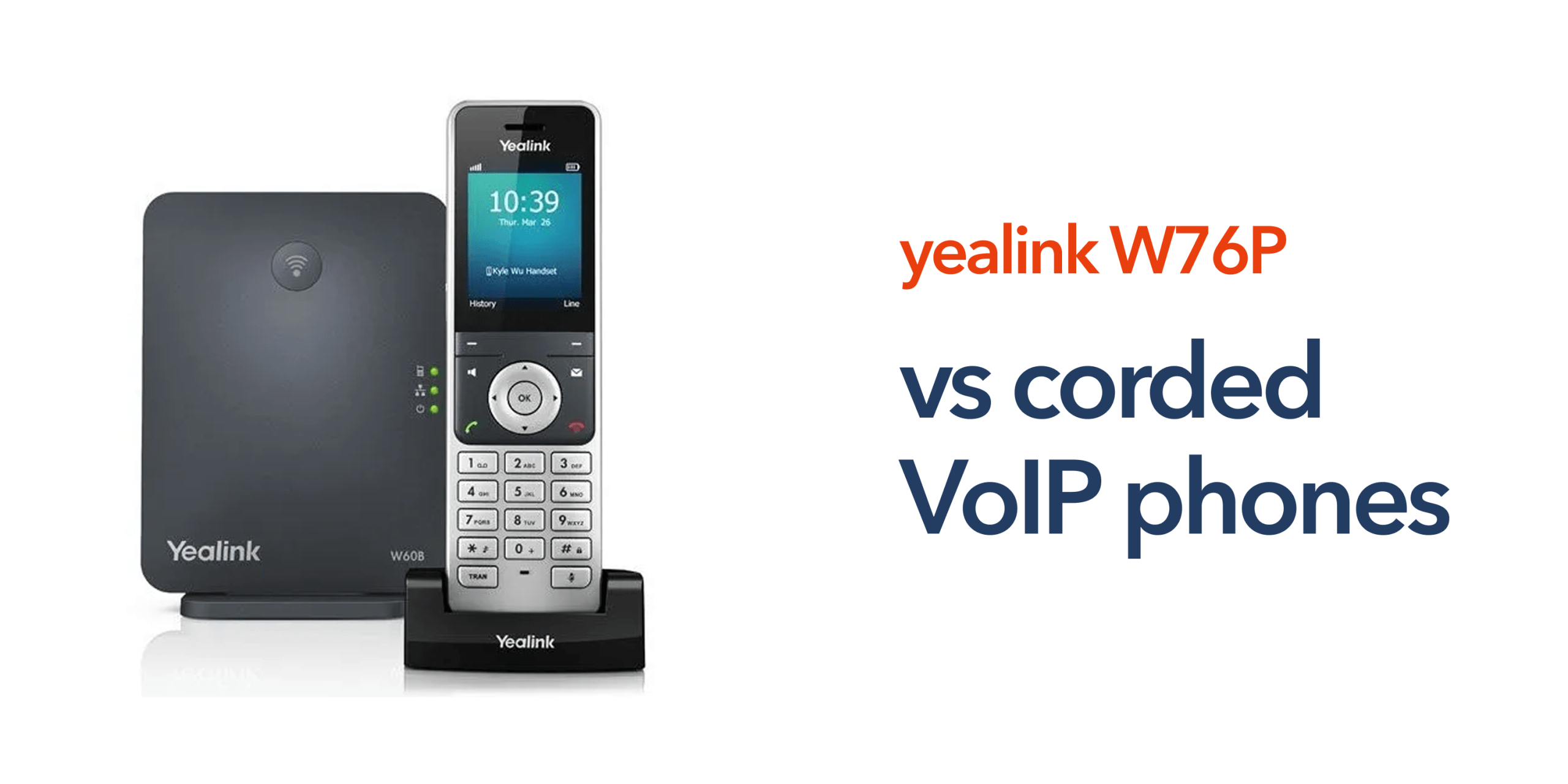
As traditional landlines are phased out across the UK, businesses are increasingly upgrading to VoIP phone systems to improve efficiency, reduce costs, and support flexible working. Many organisations now face a key decision: Yealink W76P vs corded VoIP phones. They become puzzled over whether to deploy a cordless DECT system like the W76P or rely on traditional desk-based VoIP phones.
The Yealink W76P is designed for modern workplaces that value mobility and scalability. Its cordless design allows employees to move freely across offices, retail floors, warehouses, or multi-site locations while staying connected, something corded phones cannot offer. It also supports multiple handsets per base station, enabling easy expansion as teams grow, and integrates seamlessly with cloud telephony platforms for advanced call routing, remote management, and unified communications.
While traditional corded VoIP phones provide a reliable, fixed setup suitable for desk-based teams, they lack the flexibility and adaptability of the W76P. For businesses with dynamic work environments, high mobility needs, or plans to scale, the Yealink W76P delivers not just professional call quality but also a more versatile, future-ready communication solution.
Understanding the Yealink W76P
The Yealink W76P is a wireless DECT phone system designed for business environments that require mobility. It includes a base station connected to the network and a cordless handset that communicates using digital enhanced cordless telecommunications (DECT) technology. The key capabilities include:
- Wireless communication across the workplace
- Support for multiple cordless handsets
- Integration with modern VoIP phone systems
- High-definition voice quality.
Because the handset is cordless, employees can move around the office, warehouse, or shop floor while remaining reachable.
Understanding Corded VoIP Phones
Corded VoIP phones are traditional desk-based devices that connect directly to a network via Ethernet, making them ideal for office environments where staff primarily work from a fixed desk. They typically feature large displays, programmable keys, wired network connectivity, headset support, and integration with modern cloud telephony platforms. Many businesses continue to rely on corded VoIP phones as the foundation of their communication systems, particularly in structured office settings where reliability and a consistent workspace setup are key.
Key Differences Between the Yealink W76P and Corded VoIP Phones
Although both options use voice over internet protocol, the way they operate within a business environment differs significantly. The differences include:
Mobility
One of the biggest advantages of the Yealink W76P is mobility. Employees can move freely around the office while handling calls, making it ideal for retail teams, warehouse staff, hospitality businesses, and reception areas. By comparison, corded VoIP phones require employees to remain at a fixed desk.
Installation and Infrastructure
Corded VoIP phones require Ethernet cabling at every desk. While this is common in traditional office environments, it can limit flexibility. The Yealink W76P DECT phone system, on the other hand, connects multiple handsets to a single base station, simplifying deployment in workplaces where desk cabling is limited or where mobility is a priority.
Call Handling Features
Corded VoIP phones often include more physical keys and advanced call management options. These can include multiple-line buttons, programmable function keys, and call monitoring or transfer controls, making them ideal for high-volume call environments such as call centres. The W76P focuses on simplicity and mobility while still supporting essential call features suitable for most office and customer-facing workflows.
Workplace Flexibility
Wireless systems like the Yealink W76P allow businesses to adapt their communication infrastructure as teams move around the workplace. Corded phones, however, work best when the office layout is stable, and employees remain at dedicated desks. This makes the W76P a more versatile solution for dynamic or multi-location work environments.
Business Use Cases for the Yealink W76P
The Yealink W76P business phone is commonly used in workplaces where staff are not always desk-based. Typical examples include:
- Retail Businesses: Retail teams often need to answer calls while assisting customers on the shop floor. A wireless phone allows them to stay reachable without returning to a desk.
- Warehouses and Logistics: Operational teams that move across warehouses benefit from cordless communication, staying connected across large spaces.
- Professional Services Offices: Accountants, consultants, and other professionals appreciate cordless devices that allow movement between offices, meeting rooms, and client areas.
- Small Businesses: For smaller organisations deploying their first business telephone system, the W76P offers simplicity, flexibility, and scalable enterprise-grade features.
When Corded VoIP Phones Are the Better Choice
Corded VoIP phones remain the preferred option for certain environments. These include:
Call-Heavy Roles
Support teams and reception desks often benefit from desk phones that include dedicated call-handling buttons, making it easier to manage multiple calls efficiently.
Structured Office Layouts
Businesses with fixed desks and dedicated workstations typically prefer corded VoIP devices, as they provide a stable and consistent setup for desk-based employees.
Advanced Telephony Functions
Some desk phones offer enhanced call management features, such as additional programmable keys and monitoring functions, which can be particularly useful for administrative or management roles.
How Both Devices Fit Modern Cloud Telephony
Both the Yealink W76P and corded VoIP phones operate within the same modern telecommunications framework. They connect to cloud telephony platforms, allowing calls to be handled through a business’s internet connection rather than the traditional public switched telephone network (PSTN).
This shift is particularly important as the UK prepares for the PSTN switch-off, which will replace legacy landlines with internet-based communications. By adopting VoIP devices today, businesses ensure their communications infrastructure remains compatible with modern telecom networks.
Choosing the Right Option for Your Business
Selecting between the Yealink W76P vs corded VoIP phones ultimately depends on how your team works. The W76P is ideal when employees move around the workplace, flexibility is important, and businesses need a simple wireless system. Corded VoIP phones are ideal when staff work from fixed desks, call handling features are a priority, and offices already have structured network cabling.
Many organisations are increasingly choosing the Yealink W76P as their primary solution, using cordless DECT handsets to give mobile staff the freedom to move around while maintaining connectivity, often reducing the need for fixed desk phones altogether.
Modern Business Communications With circle.cloud
Reliable devices are only one part of a modern communication system. circle.cloud helps UK businesses deploy cloud telephony, VoIP phone systems, and reliable business broadband that support devices such as the Yealink W76P and traditional VoIP desk phones. Our focus is simple. We help organisations move away from outdated infrastructure and build communication systems that support modern work. If your business is reviewing its telecom setup or preparing for the PSTN to VoIP transition, our team can help you choose the right technology. Speak to our experts today to upgrade your business communications.
FAQs
Is the Yealink W76P a VoIP phone?
Yes. The Yealink W76P uses Voice over Internet Protocol to handle calls through a business internet connection.
Are cordless VoIP phones reliable for businesses?
Yes. Modern DECT phone systems provide stable wireless communication across offices, retail environments, and warehouses.
Do corded VoIP phones have better call quality?
Call quality depends more on the network and VoIP platform than the device type. Both cordless and corded VoIP phones can deliver excellent call quality.
Can businesses use both cordless and desk VoIP phones?
Yes. Many organisations deploy a mixed setup to support both mobile staff and desk-based teams.
Is the Yealink W76P suitable for SMEs?
Yes. The device is widely used by SMEs because it offers professional communication without complex installation.