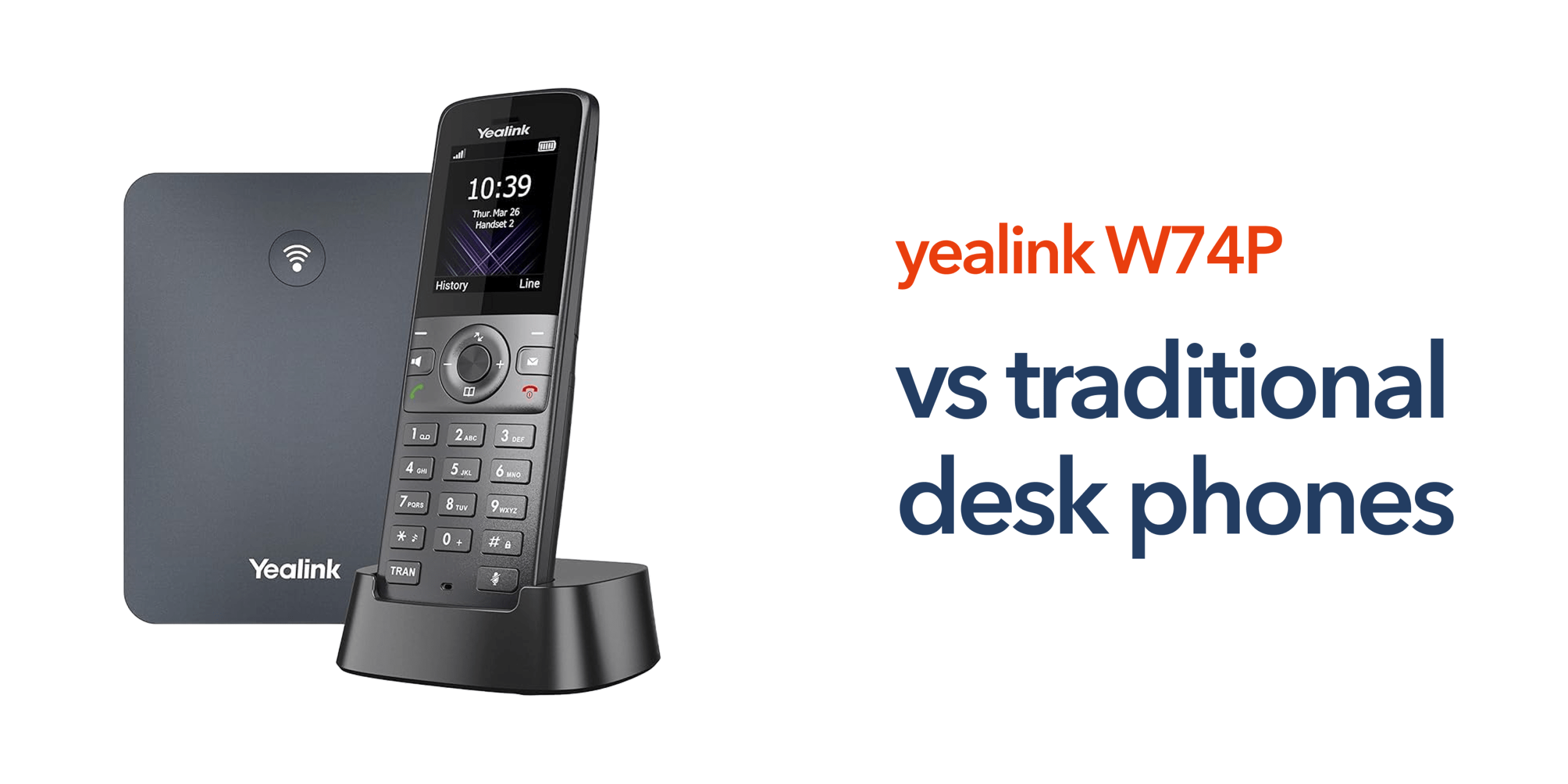
Many businesses still rely on traditional desk phones that were never designed for modern working environments. Fixed devices, limited flexibility, and infrastructure tied to legacy systems can quietly slow teams down. Employees remain tied to their desks, call handling becomes less efficient, and adapting to new ways of working can be difficult. This is where the comparison between Yealink W74P vs traditional desk phones becomes increasingly important. Cordless solutions like the Yealink W74P are designed for how businesses operate today. Using DECT wireless technology and integrating with VoIP and cloud telephony platforms, they allow employees to stay connected while moving around the workplace. This flexibility supports faster communication, better responsiveness, and improved productivity across departments.
In contrast, traditional desk phones are built around fixed locations and often depend on older telecom infrastructure such as the public switched telephone network. While they still suit certain desk-based roles, they can limit mobility and make it harder for businesses to scale or support hybrid working.
The real question is not simply which device is better. It is the communication setup that aligns with your business operations, supports your team, and prepares your organisation for the shift towards modern, cloud-based telecoms.
Understanding the Difference Between Cordless and Desk Phones
Traditional desk phones are fixed devices connected to a single location. They are often tied to legacy systems such as the public switched telephone network or on-site PBX infrastructure. The Yealink W74P uses DECT wireless technology and connects to VoIP phone systems. Instead of being tied to a desk, users can move freely within the workplace while staying connected. This difference changes how teams communicate. Desk phones are suited to static roles. Cordless phones are built for movement and flexibility.
Key Advantages of the Yealink W74P
The Yealink W74P is designed to support modern business communication by combining mobility, simplicity, and VoIP integration. It allows teams to stay connected while moving across the workplace, without being tied to a desk or fixed infrastructure.
Workplace Mobility
The Yealink W74P is built for environments where employees are constantly on the move. Using DECT wireless technology allows staff to move across offices, floors, or even separate buildings while remaining fully connected. This is particularly valuable in sectors such as retail, hospitality, and healthcare, where teams are rarely desk-based. By removing the need to stay near a fixed phone, businesses can improve response times, internal communication, and overall service delivery.
Simplified Infrastructure
Traditional desk phones often rely on fixed cabling and on-site systems that can be complex to install and manage. The Yealink W74P simplifies this by using a base station connected to your network, removing the need for extensive wiring. It integrates easily with cloud telephony platforms, making deployment faster and more straightforward. This approach reduces setup time, lowers infrastructure requirements, and makes it easier to adapt your communication system as your business evolves.
Scalability for Growing Businesses
The Yealink W74P supports multiple handsets connected to a single base station, allowing businesses to expand their communication setup without additional infrastructure. New users can be added quickly, making it ideal for growing teams or businesses opening new departments or locations. For SMEs and multi-site organisations, this provides a practical and cost-effective way to scale communications while maintaining consistency across the business.
Alignment with Modern VoIP Systems
The Yealink W74P is designed specifically for voice over internet protocol environments, making it well-suited to modern business telecoms. As UK organisations move away from PSTN and adopt cloud-based phone systems, cordless solutions like the W74P provide a natural fit. They integrate with VoIP platforms, support flexible working, and ensure communication systems are ready for future business needs.
Advantages of Traditional Desk Phones
Traditional desk phones still have a place in certain business environments, particularly where roles are structured and desk-based. While modern cordless solutions offer flexibility, desk phones continue to provide reliability and familiarity in specific use cases.
Stability for Desk-Based Roles
In offices where employees work from a fixed location, traditional desk phones offer a consistent and dependable setup. Users always know where their device is, and call handling remains predictable throughout the day. This can be beneficial in professional services environments such as finance or legal firms, where structured workflows are common.
Simple User Experience
Desk phones are typically easy to use, with familiar layouts and straightforward functionality. Employees require minimal training, which can be helpful in organisations with less technical requirements or where quick onboarding is important. For some businesses, this simplicity reduces friction and ensures communication remains efficient.
Suitable for High Call Volumes
In environments such as contact centres or support teams, traditional desk phones can provide a stable and structured platform for handling large volumes of calls. Their fixed setup allows for consistent performance, especially when paired with headsets and integrated call management systems.
Limitations of Each Option
While the Yealink W74P offers flexibility, it does have some limitations to consider. Its performance depends on reliable wireless coverage within the building, and larger or more complex environments may require additional planning to ensure consistent connectivity. It is also not always the best fit for fixed, high-volume call handling roles where a structured, desk-based setup may be preferred.
However, the limitations of traditional desk phones are often more restrictive for modern businesses. They lack mobility, keeping employees tied to a single location and limiting how teams communicate across the workplace. Many systems are still connected to legacy telecom infrastructure, making them less adaptable as organisations transition from PSTN to VoIP. Scaling can also be challenging, as adding new users often requires additional hardware and installation. Perhaps most importantly, traditional desk phones offer limited support for hybrid or flexible working, making them less suited to the way many UK businesses now operate.
Which Option Is Right for Your Business?
The right choice depends on how your team works and how your business is likely to evolve. For organisations with mobile staff, shared workspaces, or multiple locations, the Yealink W74P offers clear advantages. It supports flexible working, improves internal communication, and integrates easily with modern VoIP phone systems.
Traditional desk phones may still be suitable for businesses with fixed desk roles and consistently high call volumes, particularly in structured office environments. However, their limitations become more apparent as working patterns change. As UK businesses prepare for the PSTN switch-off, many are re-evaluating their reliance on desk-based systems that lack flexibility, are harder to scale, and do not align well with cloud-based communication.
In most cases, the decision is less about replacing one device with another and more about choosing a communication setup that supports long-term business needs.
Choosing a Future-Ready Business Phone System
The decision between the Yealink W74P and traditional desk phones is ultimately about how your business communicates today and how it will operate in the future. Modern business telecoms are moving towards cloud-based, flexible systems that support mobility and growth. The Yealink W74P fits naturally into this environment. At circle.cloud, we help UK businesses move away from outdated phone systems and adopt simple, reliable VoIP solutions that are designed for modern work. If you are reviewing your current setup or planning a transition from PSTN to VoIP, speak to our team. We will help you choose a system that works now and scales with your business.
FAQs:
Is the Yealink W74P better than a desk phone?
It depends on your business needs. The W74P is better suited for mobile environments, while desk phones work well for fixed roles.
Can the Yealink W74P replace traditional desk phones?
Yes. Many businesses are replacing desk phones with cordless VoIP systems as part of their move to cloud telephony.
Do desk phones still work after the PSTN switch-off?
Traditional PSTN-based desk phones will no longer function without VoIP adaptation. Businesses will need to migrate to IP-based systems.
Is call quality better on cordless or desk phones?
Both can deliver high-quality audio when properly configured. However, VoIP systems with good connectivity often provide more consistent performance.
Which is more cost-effective long-term?
Cordless VoIP systems are typically more scalable and cost-effective over time, especially for growing businesses.