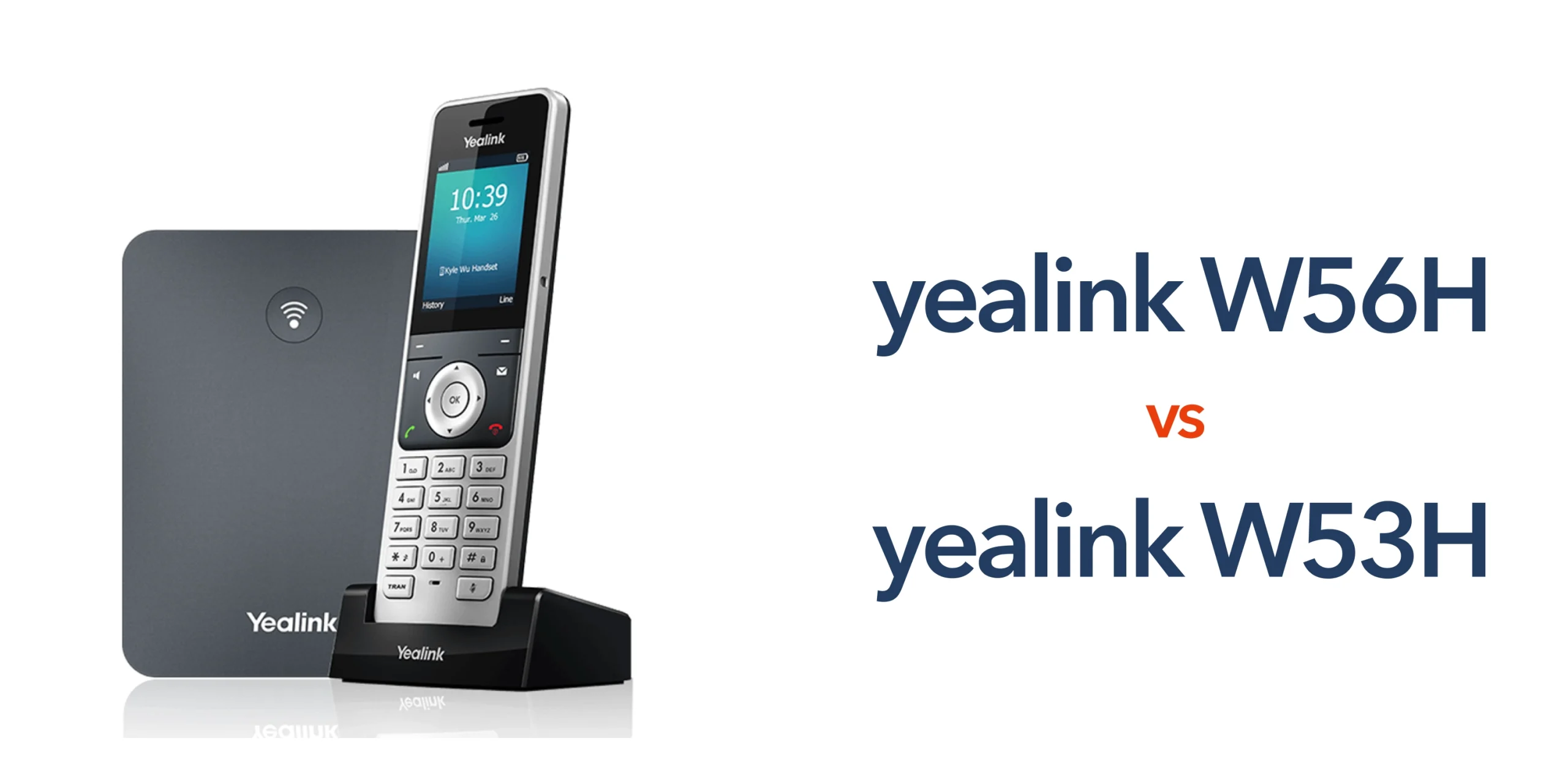
Many businesses moving to VoIP focus heavily on the phone system itself, but give less attention to the handset. In practice, the handset plays a key role in how your team communicates day to day. It affects ease of use, call handling efficiency, and overall user experience. When comparing Yealink W56H vs W53H, the difference is not just about specifications. It comes down to how your business operates. Factors such as staff mobility, call volume, and working environment all influence which device is more suitable.
Both models use DECT technology, providing reliable wireless coverage within the workplace. They are designed to work seamlessly with modern cloud telephony platforms, supporting the shift away from legacy systems such as PSTN. This makes them well-suited to businesses upgrading their communications infrastructure. However, they are positioned differently. The Yealink W56H is built with a more premium feel and enhanced usability for frequent use. The Yealink W53H is designed as a practical, cost-effective solution for everyday business communication.
Choosing between them is less about which device is better overall and more about which one fits your operational needs.
Overview of Yealink W56H and W53H
The Yealink W56H and Yealink W53H are both part of Yealink’s wireless DECT portfolio, built for modern voice over internet protocol (VoIP) environments. They are designed to integrate with cloud-based phone systems, allowing businesses to move away from legacy infrastructure such as PSTN and ISDN and adopt more flexible, scalable communication. Both handsets work seamlessly with cloud telephony platforms, supporting centralised call management, user configuration, and system scalability. This makes them well-suited to organisations upgrading their business telephone systems or preparing for the UK’s transition to digital communications.
At a high level:
- Yealink W56H is designed as a more premium handset, offering improved ergonomics and a more refined user experience for teams that handle frequent calls.
- Yealink W53H is a practical, cost-effective option, ideal for everyday business use and larger deployments where budget efficiency is important.
Both devices support the core features expected in a modern business phone system, including HD voice quality for clear communication, call handling features such as transfer, hold, and forwarding, multi-handset support on a single base station, and reliable wireless connectivity using DECT technology.
This means both models deliver dependable performance within a wider VoIP phone system, with the final choice depending on how your business balances usability, scale, and cost.
Key Differences Between Yealink W56H vs W53H
Understanding the key differences between the Yealink W56H and W53H helps you choose the right handset for your working environment. While both devices offer similar core functionality, the distinctions come down to usability, design, and how they perform in day-to-day business use.
Design and Build Quality
The Yealink W56H has a more refined design, with a slightly larger handset and improved ergonomics that make it more comfortable for frequent, all-day use. It feels more premium in hand, which can make a noticeable difference for employees who rely heavily on voice communication.
The W53H is more compact and lightweight. It is built for practicality, offering durability and ease of use without focusing on premium materials or design. This makes it well-suited to general business environments where simplicity and reliability are the priority.
For teams that spend long periods on calls, the W56H typically provides a more comfortable and user-friendly experience.
Screen and User Experience
The W56H features a larger display and a more polished interface, making it easier to navigate menus, manage contacts, and handle calls efficiently. This is particularly valuable in fast-paced environments where users need quick access to features.
The W53H has a smaller screen with a more basic interface. While it performs reliably, it is better suited to users with lighter call-handling needs rather than those who interact with the handset constantly.
Battery Performance
Both devices are designed to last through a full working day, supporting typical business usage without frequent charging.
The W53H often delivers slightly longer standby time due to its simpler design and lower power demands. However, in real-world business environments, both handsets provide dependable battery performance for day-to-day operations.
Performance and Features
From a functionality perspective, both handsets deliver the core capabilities expected from modern Yealink VoIP phones, including:
- HD voice quality for clear and consistent communication
- Reliable DECT wireless connectivity within the workplace
- Multi-handset support across a single base station
- Integration with cloud-based VoIP phone systems
The key difference is not in what they can do, but in how they feel when being used. The W56H focuses on enhanced usability, while the W53H prioritises simplicity and cost efficiency.
Price and Deployment Considerations
The W53H is generally more cost-effective, making it a practical choice for businesses rolling out devices across multiple users or locations.
The W56H comes at a higher price point but offers improved comfort and a more refined user experience. This makes it a strong option for staff who spend a significant amount of time on calls.
For many organisations, the decision comes down to deployment strategy. Larger teams may benefit from the affordability of the W53H, while key users or customer-facing roles may justify the added investment in the W56H.
The table below offers a better comparison for businesses and users.
| Feature | Yealink W56H | Yealink W53H |
| Design & Build | Premium feel, larger and ergonomic | Compact, lightweight, practical design |
| User Comfort | Better for frequent, all-day use | Suitable for occasional to moderate use |
| Display | Larger screen, clearer interface | Smaller screen, more basic interface |
| User Experience | More refined and easier navigation | Simple and functional |
| Battery Performance | Strong full-day performance | Slightly longer standby time |
| Core Features | HD voice, DECT, multi-handset support | HD voice, DECT, multi-handset support |
| VoIP Integration | Full compatibility with VoIP systems | Full compatibility with VoIP systems |
| Target Use Case | High call volume, key staff | General business use, wider teams |
| Deployment Strategy | Best for selective or premium users | Ideal for large-scale deployments |
| Price Positioning | Higher cost | More cost-effective |
Which Handset Is Right for Your Business?
For office-based businesses such as accountants and professional services, both the Yealink W56H and W53H perform well, with the W53H suited to standard day-to-day use and the W56H better for users handling higher call volumes who benefit from improved comfort.
In retail and customer-facing environments, mobility is critical, as staff need to stay connected while assisting customers, and while both devices support this, the W56H offers a more comfortable experience for frequent use, which is important for businesses using VoIP for retail, where responsiveness matters.
In multi-user or scalable environments, the W53H provides better cost efficiency for wider deployment across teams, while the W56H is more suitable for key staff or managers who rely heavily on communication, with many businesses choosing a mixed deployment to balance usability and cost.
How These Devices Fit Into Modern Business Telecoms
Wireless handsets are only one part of your communication setup. To get full value, they need to work alongside a reliable business broadband connection, a cloud-based phone system, and properly configured call routing and users. Many VoIP issues are not caused by the handset itself, but by poor configuration or unreliable infrastructure. As UK businesses move away from PSTN towards cloud-based systems, having the right setup in place ensures reliable and scalable communication.
Making the Right Choice for Your Setup
If your priority is cost-effective deployment across teams, the W53H is a strong choice. If your priority is user comfort, frequent call handling, and a more premium experience, the W56H is the better fit. Many UK businesses benefit from combining both, aligning devices with real usage rather than treating every user the same. The key is ensuring your handset choice supports your wider communication strategy. With the right setup, your telecoms become simpler, more reliable, and easier to scale as your business grows. If you are reviewing your current system or planning a move from PSTN to VoIP, speaking to a telecom specialist can help you make the right decision from the start.
FAQs
What is the main difference between Yealink W56H vs W53H?
The main difference is design and user experience. The W56H offers a more premium feel and larger display, while the W53H is more cost-effective and compact.
Are both handsets compatible with VoIP systems?
Yes. Both are designed for use with modern VoIP and cloud-based phone systems.
Which handset is better for small businesses?
The W53H is often better for small businesses due to its lower cost, especially when deploying multiple devices.
Can you use both handsets in the same system?
Yes. Many businesses use a combination of both, depending on user requirements.