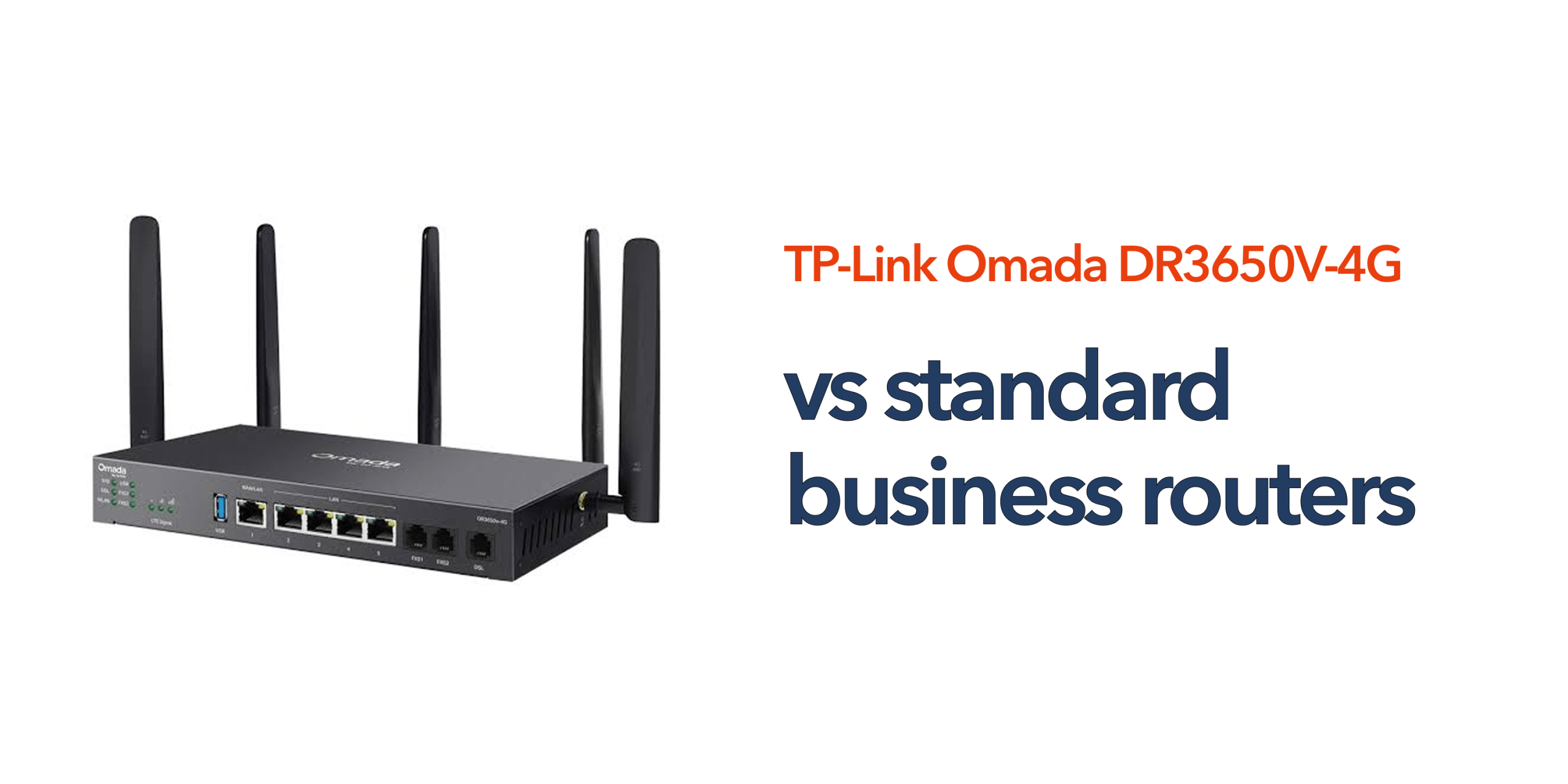
Modern businesses rely on cloud applications, VoIP phone systems, video conferencing, and remote working tools every day. As a result, choosing the right business routers has become more important than ever. Many organisations still use traditional business routers that provide reliable internet connectivity but offer limited protection against service outages. Newer solutions, such as the TP-Link Omada DR3650V-4G, are designed to go further by combining routing capabilities with integrated 4G backup and failover functionality.
So how does the TP-Link Omada DR3650V-4G compare to standard business routers, and which option is best for your organisation? Let’s find out.
What Are Business Routers?
Business routers are networking devices that connect an organisation’s local network to the internet. Unlike consumer-grade routers, business routers are designed to support:
- Multiple users
- Higher traffic volumes
- Enhanced security
- Network management tools
- VPN connectivity
- Reliable performance
For many SMEs, the router acts as the foundation of their entire communications infrastructure.
How Standard Business Routers Work
Traditional business routers focus primarily on managing internet traffic between your internal network and your broadband connection. Typical features include firewall protection, VPN support, traffic management, network segmentation, multiple LAN ports, and wireless connectivity support.
These capabilities make standard business routers suitable for many organisations. However, most rely entirely on a single broadband connection. If that connection fails, internet access is lost until service is restored.
The Challenge with Single-Connection Routers
Businesses today depend on internet connectivity for essential operations. Without internet access, organisations can quickly lose access to hosted VoIP phone systems, Microsoft 365, CRM platforms, cloud storage, video conferencing, and customer support systems. Even short outages can result in missed customer calls, reduced productivity, delayed responses, interrupted meetings, and frustrated employees. This is where newer business routers are starting to offer significant advantages.
What Makes the TP-Link Omada DR3650V-4G Different?
The TP-Link Omada DR3650V-4G combines traditional routing functionality with integrated 4G connectivity. Rather than relying entirely on a fixed broadband service, the router can automatically switch to a mobile network connection if the primary service becomes unavailable. This functionality is commonly known as automatic failover. The result is improved connectivity resilience without requiring a separate backup device.
TP-Link Omada DR3650V-4G vs Standard Business Routers
While standard business routers provide reliable networking capabilities, modern organisations increasingly require more than basic internet connectivity. Features such as automatic failover, connectivity resilience, and simplified management are becoming important considerations as businesses rely more heavily on cloud-based services and communications.
The TP-Link Omada DR3650V-4G addresses these evolving requirements by combining business-grade routing with integrated 4G backup, helping organisations stay connected when unexpected broadband outages occur.
Internet Resilience
One of the biggest differences between the TP-Link Omada DR3650V-4G and many traditional business routers is how they handle connectivity disruptions. As businesses become increasingly dependent on internet access, resilience is no longer a luxury but an essential part of network planning.
Standard Business Routers Most standard business routers are designed to deliver reliable day-to-day connectivity but typically depend on a single broadband connection. If that service experiences a fault, outage, or disruption, internet access is lost until the issue is resolved, potentially affecting critical business operations.
TP-Link Omada DR3650V-4G The TP-Link Omada DR3650V-4G is built with resilience in mind. Its integrated 4G failover capability provides an alternative connection path, automatically switching to the mobile network when broadband becomes unavailable. This helps businesses maintain connectivity and minimise the impact of unexpected outages.
Business Continuity
Internet outages can affect far more than web browsing. They can disrupt communications, customer service, and access to critical business systems. This makes business continuity a key consideration when comparing router solutions.
Standard Business Routers For businesses that rely heavily on cloud services, even a short internet outage can cause significant disruption. Employees may lose access to communication tools, customer systems, and essential applications, leading to reduced productivity and service delays.
TP-Link Omada DR3650V-4G With automatic failover functionality, the DR3650V-4G helps keep business-critical systems accessible during connectivity issues. Access to cloud communications, email services, CRM platforms, and other online applications can continue while the primary connection is being restored.
Deployment Simplicity
For many SMEs, networking solutions need to be effective without becoming difficult to manage. The ease of deployment and ongoing administration can significantly influence the overall value of a router.
Standard Business Routers Improving resilience with a standard router often requires additional hardware such as external 4G backup devices, secondary broadband connections, or separate failover solutions. This can increase deployment complexity and ongoing management requirements.
TP-Link Omada DR3650V-4G The DR3650V-4G simplifies deployment by combining business routing and 4G backup functionality into a single device. This integrated approach reduces the need for additional equipment and makes it easier for SMEs to implement a more resilient network.
Cost Efficiency
When evaluating networking equipment, it is important to consider the total cost of achieving reliable connectivity. The most affordable router is not always the most cost-effective solution if additional hardware or services are required.
Standard Business Routers Creating a highly resilient network using traditional routers can involve purchasing separate failover equipment or installing secondary internet circuits. While effective, these solutions can increase both upfront and ongoing costs.
TP-Link Omada DR3650V-4G By incorporating 4G failover directly into the router, the DR3650V-4G offers a more cost-effective way to improve connectivity resilience. For many SMEs, it provides a practical balance between reliability and affordability without requiring significant infrastructure investment.
Support for Cloud-First Communications
Modern businesses increasingly rely on cloud-based applications and communication platforms. The ability to maintain stable access to these services can have a direct impact on productivity, customer experience, and operational performance.
Standard Business Routers Standard business routers generally perform well when broadband services are operating normally. However, they can leave businesses vulnerable during outages, particularly if essential communications and productivity tools are cloud-based.
TP-Link Omada DR3650V-4G The ability to maintain connectivity through automatic failover makes the DR3650V-4G particularly valuable for organisations using cloud-first communications. Hosted VoIP systems, Microsoft 365, collaboration platforms, and customer service applications can remain accessible, helping employees stay productive and responsive during connectivity disruptions.
TP-Link Omada DR3650V-4G vs Standard Business Routers Comparison Table
The table below provides a clear side-by-side comparison of the TP-Link Omada DR3650V-4G and standard business routers, highlighting key differences in resilience, deployment, and overall business performance. It helps organisations quickly understand which solution better supports modern connectivity needs.
| Feature | TP-Link Omada DR3650V-4G | Standard Business Routers |
|---|---|---|
| Internet Connectivity | Uses primary broadband with integrated 4G backup | Relies only on a single broadband connection |
| Failover Capability | Automatic 4G failover for improved continuity | No built-in failover, requires external solutions |
| Internet Resilience | Higher resilience with automatic network switching | Low resilience, downtime during outages |
| Business Continuity | Maintains access to cloud apps and VoIP during outages | Services go offline until broadband is restored |
| Deployment | Simple, all-in-one setup with fewer devices | May require extra hardware for backup connectivity |
| Management | Centralised Omada cloud-based management | Traditional standalone router management |
| Cost Efficiency | More cost-effective due to built-in failover | Lower initial cost but higher backup setup costs |
| Scalability | Easily scalable within the Omada ecosystem | Limited scalability without additional infrastructure |
| Cloud Support | Strong support for cloud-first communications | Dependent on stable broadband only |
| Best For | SMEs, remote teams, cloud-reliant businesses | Basic networking with no advanced resilience needs |
Overall, the comparison clearly shows that the TP-Link Omada DR3650V-4G offers a more resilient, flexible, and business-ready solution, making it the stronger choice for organisations that prioritise uptime and continuity.
Which Businesses Benefit Most from Integrated 4G Failover?
Not every organisation has the same connectivity requirements, but for many SMEs and growing businesses, integrated 4G failover provides a simple and effective way to improve resilience without adding complexity. It is particularly valuable where internet access directly impacts communication, productivity, and customer experience. The TP-Link Omada DR3650V-4G can be particularly valuable for:
- Small Businesses: SMEs often lack dedicated IT resources and need straightforward solutions that improve reliability without adding complexity. A single device with built-in failover helps reduce downtime with minimal management overhead.
- Remote and Hybrid Workforces: Businesses with remote workers depend heavily on uninterrupted access to cloud applications and communication tools. Integrated 4G failover helps maintain productivity when broadband issues occur at any location.
- Customer-Facing Organisations: Companies that rely on incoming calls, online bookings, or cloud-based customer systems can benefit from improved uptime. Even short outages can impact service delivery and customer satisfaction.
- Multi-Site Businesses: Organisations operating across multiple locations often need consistent connectivity to maintain communication and collaboration. Centralised resilience helps ensure all sites remain operational during connectivity disruptions.
Are Standard Business Routers Still a Good Choice?
Absolutely. For organisations with minimal reliance on cloud applications or those already using alternative resilience measures, traditional business routers remain a practical solution. They continue to offer strong security, reliable routing performance, and network management capabilities. However, as more business systems move online, connectivity resilience is becoming an increasingly important factor when evaluating business routers.
Choosing the Right Router for Your Business
When comparing business routers, it is important to consider more than speed and technical specifications. Ask the following questions:
- What happens if broadband fails?
- How much downtime can the business tolerate?
- Which systems rely on internet access?
- How many employees depend on cloud applications?
- Is there an existing backup connectivity solution?
The answers often determine whether a traditional router is sufficient or whether integrated failover capabilities provide additional value.
Conclusion
The best business routers do more than simply connect your network to the internet. They help support productivity, protect business continuity, and reduce the impact of unexpected connectivity issues. While standard business routers remain suitable for many organisations, solutions such as the TP-Link Omada DR3650V-4G offer an additional layer of resilience through integrated 4G failover. For businesses that depend on cloud communications, VoIP services, and online applications, that added protection can make a significant difference when outages occur.
As modern business telecoms continue to evolve, connectivity resilience is becoming just as important as connectivity itself. Speak to circle.cloud to find the right business router and connectivity setup for your organisation.
FAQs
What is the main difference between the TP-Link Omada DR3650V-4G and a standard business router? The DR3650V-4G includes built-in 4G failover, while standard routers rely only on fixed broadband with no automatic backup connection.
How does 4G failover improve business connectivity? It automatically switches to a mobile network when broadband fails, helping keep cloud apps, VoIP, and communications running.
Do standard business routers support internet backup options? Most do not have built-in backup and usually require extra hardware or a second internet line to achieve failover.
Is the TP-Link Omada DR3650V-4G suitable for small businesses? Yes, it is designed for SMEs needing a simple setup and reliable connectivity without complex additional equipment.
When should a business consider upgrading to a 4G failover router? If downtime affects cloud tools, customer calls, or remote work, upgrading to a router like TP-Link Omada DR3650V-4G improves continuity and reduces disruption.