Published: 1st October 2026 · Last updated: 1st October 2026
Reviewed by: circle.cloud Team · Last Reviewed: 1st October 2026
Reading time: Approximately 15 minutes · Revision: Version 1.0
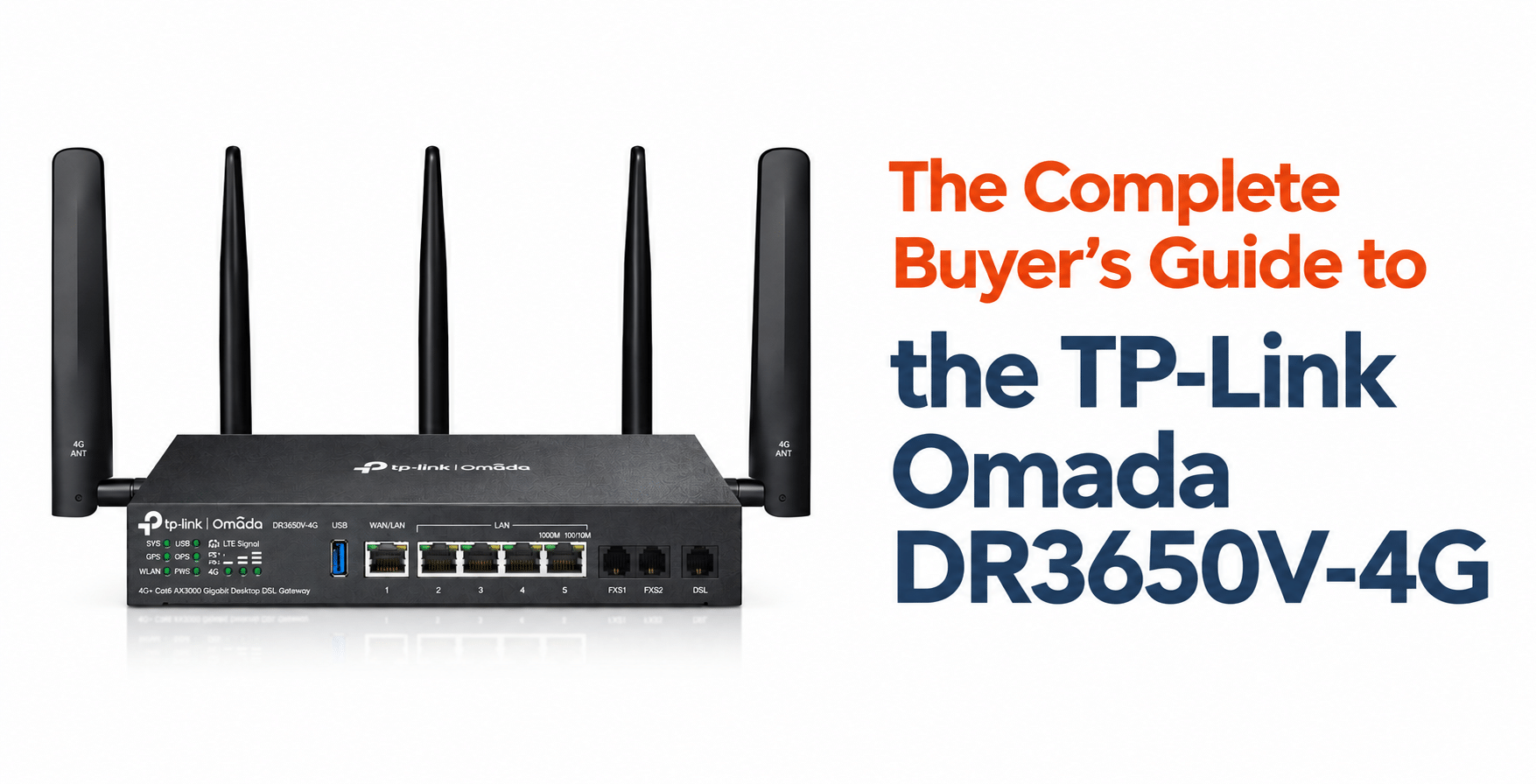
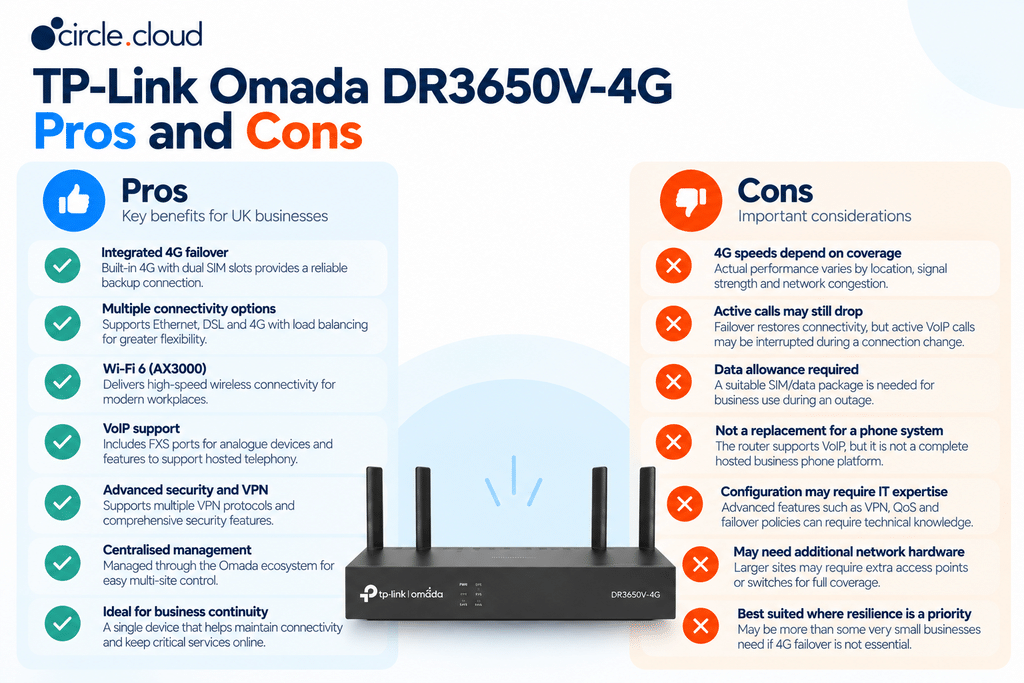
The TP-Link Omada DR3650V-4G is a business gateway designed to combine fixed-line connectivity, 4G backup, Wi-Fi 6, routing, VPN capabilities, VoIP support and centralised Omada management within one device. Its most important role for many UK businesses is not simply providing internet access, but helping maintain connectivity when the primary connection fails. It offers 4G+ Cat6 connectivity of up to 300Mbps under specified conditions, dual Nano-SIM slots for 4G/LTE failover, Wi-Fi 6 AX3000, a VDSL2 35b DSL port, Gigabit Ethernet WAN, four Gigabit LAN ports and two FXS ports.
For businesses using hosted VoIP, Microsoft 365, CRM systems, cloud applications, online payment services or remote working tools, that resilience can be commercially important. If the internet connection goes down, the consequences can extend well beyond employees being unable to browse the web. Customer calls may fail, cloud systems may become inaccessible, and staff may be unable to process normal workloads.
The DR3650V-4G is therefore best assessed as part of a wider communications infrastructure rather than as an isolated router.
Key Takeaways
- Built for connectivity resilience: The TP-Link Omada DR3650V-4G combines broadband, Ethernet and 4G+ Cat6 connectivity, helping businesses maintain internet access if their primary connection fails.
- Automatic 4G failover: Dual Nano-SIM support allows the router to provide a backup mobile connection, helping reduce disruption during broadband outages.
- Supports business telephony: With integrated VoIP support and two FXS ports, the DR3650V-4G can form part of a wider business communications setup.
- Wi-Fi 6 for modern workplaces: AX3000 Wi-Fi 6 provides high-speed wireless connectivity for compatible business devices, with support for features such as MU-MIMO and OFDMA.
- Flexible connectivity options: The router supports VDSL2, Ethernet WAN and 4G LTE, giving businesses more flexibility when designing their connectivity infrastructure.
- Centralised Omada management: Businesses can manage and monitor supported network infrastructure through the Omada platform, making it particularly useful for managed and multi-site environments.
- Useful across multiple sectors: The DR3650V-4G can suit organisations such as care homes, manufacturing businesses, engineering firms, automotive operators, dental practices, estate agents and multi-site businesses where reliable connectivity is important.
- Part of a wider resilience strategy: The router works alongside business broadband or leased line connectivity, hosted business telephony and managed networking to create a more resilient communications infrastructure.
TP-Link Omada DR3650V-4G at a Glance
| Specification | TP-Link Omada DR3650V-4G |
|---|---|
| Primary role | Business gateway / router |
| 4G | 4G+ Cat6 |
| 4G maximum | Up to 300Mbps under specified conditions |
| SIM | 2 × Nano-SIM |
| Wi-Fi | Wi-Fi 6 AX3000 |
| Wi-Fi rates | 2,402Mbps at 5GHz + 574Mbps at 2.4GHz |
| DSL | VDSL2 35b up to 350Mbps access (manufacturer maximum; UK Openreach FTTC currently tops out at 80Mbps) |
| Ethernet | 1 × Gigabit WAN/LAN + 4 × Gigabit LAN |
| Voice | 2 × FXS ports with VoIP support |
| USB | USB 3.0 |
| VPN | IPSec, PPTP, L2TP, OpenVPN, WireGuard, GRE and SSL VPN |
| Management | Omada centralised management |
| Mounting | Desktop or wall mounting |
Note: Specifications can vary by firmware or product revision, so businesses should confirm the current configuration before purchase. TP-Link’s current product documentation identifies the core features above.
Who This Guide Is For
This guide is designed for UK businesses evaluating whether the TP-Link Omada DR3650V-4G is suitable for their connectivity requirements. It is particularly relevant to SMEs, multi-site organisations and businesses where an internet outage could disrupt customer communication, cloud applications, payments or day-to-day operations. It can also help IT managers, business owners and operations teams understand where 4G failover, Wi-Fi 6, VoIP support and centralised network management fit into a wider connectivity strategy.
Why Trust This Guide
This guide is intended to provide practical buying guidance rather than simply reproduce manufacturer specifications. It considers the DR3650V-4G in the context of real business requirements, including connectivity resilience, 4G failover, network management, business telephony and deployment considerations. Our recommendations are based on the technical capabilities of the DR3650V-4G, its potential business use cases and the wider requirements of modern business communications. circle.cloud takes a consultative approach to business connectivity, considering how broadband, backup connectivity, networking and hosted telephony need to work together rather than treating each product in isolation. The aim is to help readers understand both what the router offers and the situations where its features may or may not be appropriate.
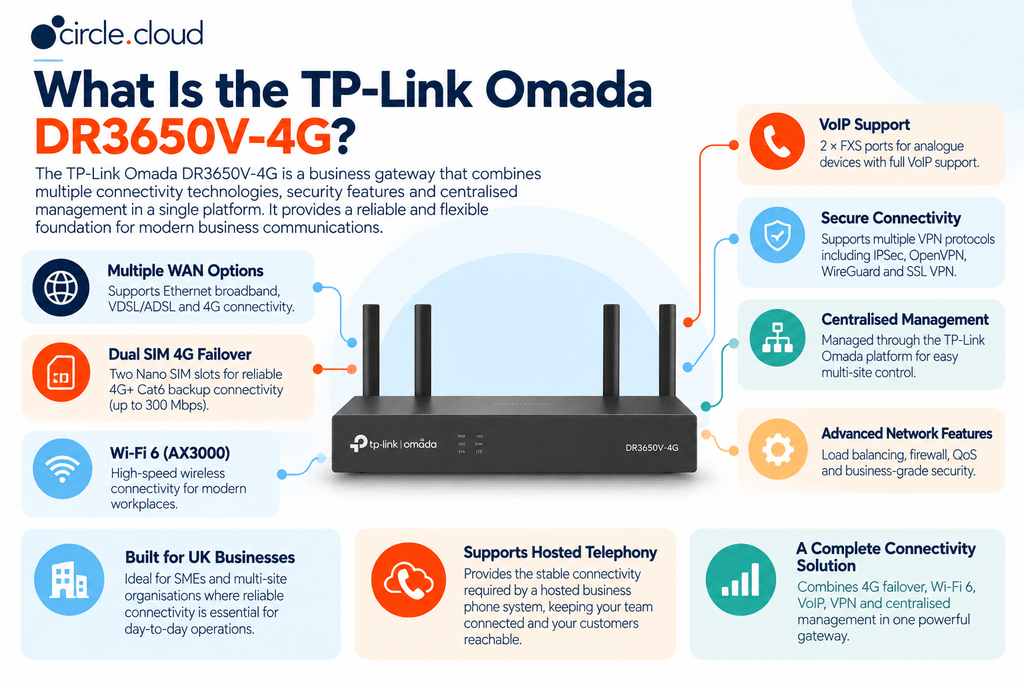
What Is the TP-Link Omada DR3650V-4G?
The TP-Link Omada DR3650V-4G is an Omada business gateway that combines several connectivity technologies into a single platform. Its architecture allows a business to use a primary connection such as Ethernet broadband or DSL while retaining 4G connectivity as a backup route. The DR3650V-4G also supports load balancing across DSL, 4G and Ethernet WAN, giving IT teams flexibility in how connections are used.
The device also incorporates Wi-Fi 6, VPN functionality, network security features, VoIP support and centralised management through the Omada ecosystem. That combination makes it particularly relevant to SMEs and multi-site businesses where internet connectivity is now part of the operational infrastructure rather than simply an IT convenience.
For circle.cloud customers, this is particularly relevant because a hosted business telephone system relies on the underlying network. The telephone handset may sit on a desk, but the service itself depends on the router, broadband connection, local network and wider internet path working correctly.
Why Connectivity Resilience Matters for UK Businesses
A business can survive a slow internet connection more easily than a complete loss of connectivity. Consider an estate agency. Its negotiators may need to answer calls from buyers and vendors, access property management software, send documents and communicate with solicitors. If connectivity disappears, several of those activities can be affected at the same time. The same principle applies to a dental practice using cloud-based systems, a manufacturer coordinating suppliers, an engineering company managing remote projects or an automotive dealership handling customer enquiries.
For a telephone-dependent business, connectivity is part of the customer journey. This is becoming even more important as the UK moves away from legacy telephone infrastructure. BT has confirmed that the traditional PSTN network is due to close on 31 January 2027, while businesses are being encouraged to migrate services to modern digital alternatives.
The important distinction is that the PSTN switch-off does not mean every business must buy this particular router. Instead, it reinforces a broader requirement: businesses moving towards hosted VoIP and IP-based communications need a dependable internet connection and a sensible resilience strategy.
The Feature That Matters Most: Integrated 4G Failover
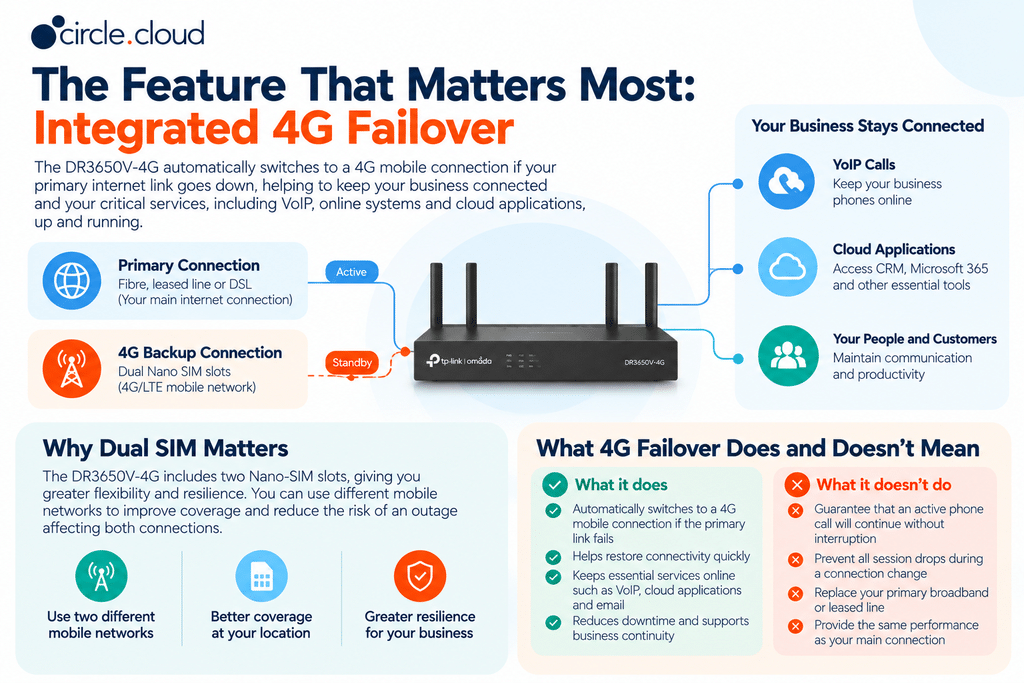
The defining feature of the DR3650V-4G is its ability to provide a mobile backup connection without requiring a completely separate 4G router. The router supports two Nano-SIM slots for 4G/LTE failover. If the primary connection becomes unavailable, the network can be configured to use the mobile connection as an alternative route. For a business using hosted VoIP, this can provide an additional layer of resilience.
However, businesses should understand what failover does and does not mean. It does not guarantee that an active phone call will continue without interruption when the primary connection fails. A connection change can cause active sessions to drop and reconnect. The objective is to restore connectivity and keep essential services available rather than guarantee seamless continuation of every existing session.
circle.cloud’s existing guidance on the DR3650V-4G similarly highlights the importance of treating 4G as business continuity infrastructure rather than simply another internet connection.
Why dual SIM matters
The two Nano-SIM slots provide another resilience option. A business can plan its mobile backup around suitable mobile network availability rather than assuming that one SIM and one mobile network will always be sufficient. The correct approach depends on local coverage, the networks available at the premises and the organisation’s data requirements. Before deployment, test the actual location. A theoretical 300Mbps 4G capability is less important than whether the building receives a stable mobile signal where the router will be installed.
How the DR3650V-4G Supports Business Telephony
The DR3650V-4G is particularly interesting for businesses moving towards hosted telephony because it includes VoIP support and two FXS ports. The FXS ports allow compatible analogue telephone equipment to connect to the gateway, while IP-based phones and other network devices can connect through the Ethernet infrastructure. This makes the router flexible during a migration from traditional telephony.
The built-in VoIP function works like an analogue telephone adapter for those two FXS ports: it registers to a SIP service so that analogue handsets can make and receive calls. IP handsets and softphones do not use it; they register directly with the hosted platform across the network. Whether the FXS ports can register to a particular hosted platform should be confirmed with the provider before relying on them.
However, it should not be confused with a complete hosted business phone system. The router provides connectivity and network functionality. The hosted phone system provides the telephone service itself, including numbers, extensions, call routing, voicemail, business calling features and other platform functionality. That distinction is important when planning a business telecoms upgrade. A reliable router alone does not create a complete business communications solution.
Building the DR3650V-4G into a Complete Business Communications Setup
A typical circle.cloud deployment can be thought of as a series of connected layers:
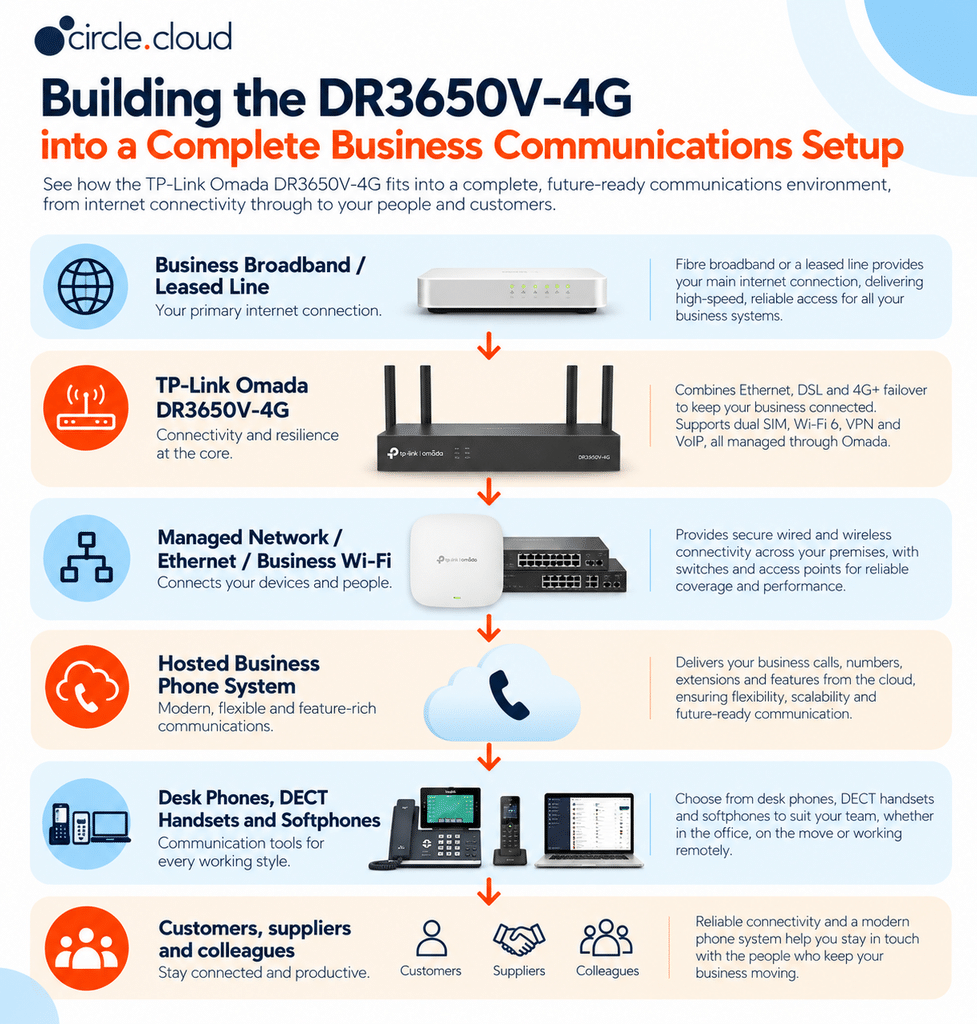
- Business broadband or leased line: the primary connection.
- DR3650V-4G gateway: routing, security, Wi-Fi 6 and the 4G failover path via dual Nano-SIM.
- Local network: switches, access points, phones, computers and other devices.
- Hosted phone system: numbers, extensions, call routing and calling features.
Each layer has a different responsibility. The broadband or leased line provides the primary connection. The DR3650V-4G manages connectivity and provides the resilience layer. The local network connects phones, computers and other devices. The hosted phone system provides the communications service.
This approach is particularly relevant to circle.cloud’s wider positioning as a technology partner providing hosted VoIP, business connectivity and managed telecom infrastructure rather than treating the telephone system as an isolated product.
Wi-Fi 6 and Wireless Networking
The DR3650V-4G is not limited to 4G backup. It incorporates AX3000 Wi-Fi 6, with a theoretical combined wireless rate of 3Gbps across its two bands: 2,402Mbps on 5GHz and 574Mbps on 2.4GHz. For smaller premises, this can make the router useful as part of the site’s wireless infrastructure rather than simply as a WAN gateway. The router’s Wi-Fi 6 implementation also supports technologies such as OFDMA, MU-MIMO, beamforming, airtime fairness and multiple SSIDs. TP-Link lists up to 16 SSIDs in total, with eight per radio.
For larger offices, however, the built-in wireless capability should not automatically be treated as a replacement for a properly designed business Wi-Fi deployment. A multi-floor office, care home, manufacturing site or multi-building premises may require dedicated Omada access points positioned according to coverage and capacity requirements. The router should therefore be selected based on the network as a whole.
VDSL, Ethernet and Fibre Connectivity
One of the advantages of the DR3650V-4G is its connectivity flexibility. It supports VDSL2 (including profile 35b, up to 350Mbps where offered) plus ADSL2+, ADSL2 and ADSL. UK Openreach FTTC services use profile 17a with a maximum of 80Mbps, so the 350Mbps figure is a manufacturer maximum rather than a speed UK businesses should expect on DSL. It also provides a Gigabit WAN/LAN port for Ethernet connectivity. This means the router can be used with different access arrangements.
For a modern UK business, an Ethernet WAN connection from a full-fibre service can provide the primary connection while the integrated 4G capability provides backup. For businesses still operating on suitable DSL services, the router can provide a migration path while retaining mobile failover. The important point is to choose the primary connectivity service according to the business requirement rather than selecting a router first and assuming the internet service will fit afterwards.
VPN and Secure Remote Connectivity
The DR3650V-4G also supports a broad selection of VPN technologies, including IPSec, OpenVPN, WireGuard, GRE and SSL VPN. This can be useful for businesses with multiple locations or remote users that need secure connectivity between sites and services. For example, an engineering company may have a main office and a satellite location. An automotive business may operate a showroom and workshop across separate areas. A care organisation may have several premises requiring consistent connectivity and centralised oversight.
The exact VPN design should be based on the organisation’s security requirements, addressing scheme and applications. PPTP and plain L2TP are also supported, but these are legacy protocols with known weaknesses and should not be used for new business deployments; IPSec, OpenVPN or WireGuard are the appropriate choices. A router supporting VPN protocols does not automatically mean the network has been securely configured.
Centralised Omada Management
One of the DR3650V-4G’s biggest advantages for growing businesses is its integration with the Omada management ecosystem. TP-Link supports centralised cloud management for compatible Omada gateways, switches and access points. Administrators can manage the network through the Omada platform and use features such as centralised configuration, monitoring and alerts. This becomes more valuable as the number of sites increases.
A single-site SME may have relatively straightforward requirements. A business with five, ten or more locations has a very different management problem. Centralised visibility can reduce the need to treat every branch as an entirely separate networking project. This is particularly relevant to estate agencies, automotive groups, care providers and other organisations operating multiple sites.
Which Businesses Should Consider the DR3650V-4G?
The most suitable customer is not defined purely by employee count. The more important question is: “What happens to the business if its internet connection stops working?”
If the answer includes missed customer calls, lost orders, disrupted appointments, inaccessible systems or staff unable to work, resilient connectivity deserves serious consideration.
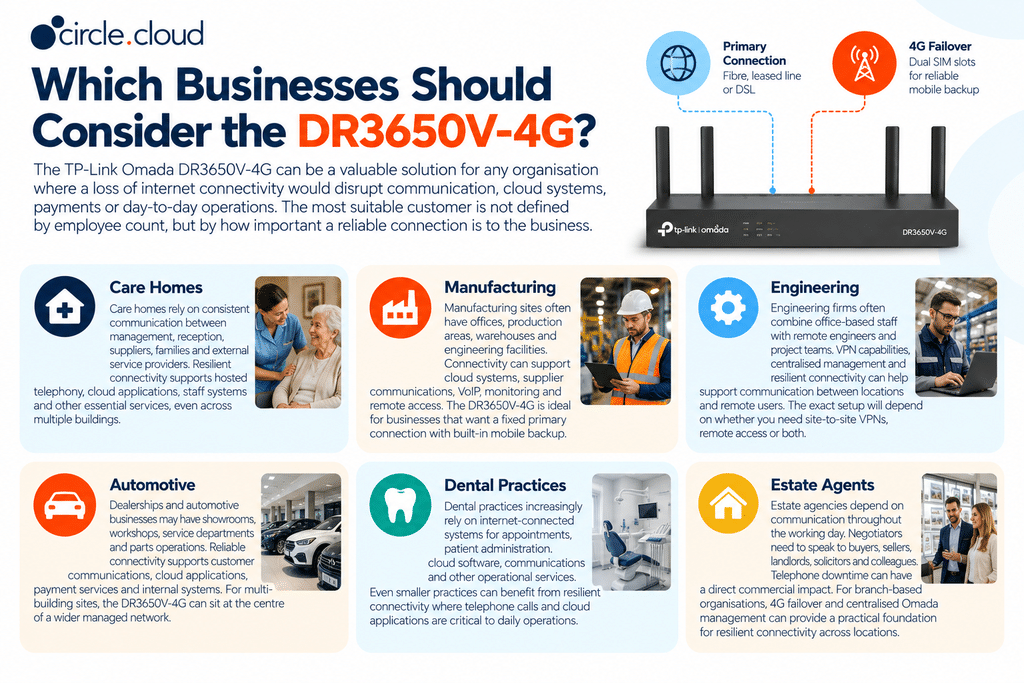
Care Homes
Care homes depend on reliable communication between management, reception, suppliers, families and external service providers. A resilient network can support hosted telephony, cloud applications, staff systems and other connected services. Because care environments can also contain multiple buildings and areas, the wider network design is important. The DR3650V-4G can provide the gateway and failover layer, while additional Omada access points or network infrastructure may be required elsewhere.
Manufacturing
Manufacturing sites can have a mixture of offices, production areas, warehouses and engineering facilities. Connectivity may support cloud systems, supplier communications, VoIP, monitoring and remote access. An outage can therefore affect more than office staff. The DR3650V-4G is particularly relevant where the organisation wants a fixed primary connection backed by mobile connectivity without introducing a separate backup router.
Engineering
Engineering firms often combine office-based staff with remote engineers and project teams. VPN capabilities, centralised management and resilient connectivity can help support communication between locations and remote users. The exact architecture will depend on whether the organisation needs site-to-site VPNs, remote access or both.
Automotive
Dealerships and automotive businesses may have showrooms, workshops, service departments and parts operations. Reliable connectivity can support customer communications, cloud applications, payment services and internal systems. For multi-building automotive sites, the DR3650V-4G can sit at the centre of a wider managed network.
Dental Practices
Dental practices increasingly rely on internet-connected systems for appointments, patient administration, cloud software, communications and other operational services. A small practice may not need a highly complex network, but resilient connectivity can still be valuable where telephone calls and cloud applications are critical to daily operations.
Estate Agents
Estate agencies are particularly dependent on communication. Negotiators need to speak to buyers, sellers, landlords, solicitors and colleagues throughout the working day. Telephone downtime can therefore have a direct commercial impact. For branch-based organisations, the combination of 4G failover and centralised Omada management can provide a practical foundation for resilient connectivity across locations.
Multi-Site Businesses
The DR3650V-4G becomes particularly interesting when an organisation operates multiple locations. Rather than managing every branch as an isolated network, Omada provides a route towards centralised management of compatible networking equipment. A typical multi-site architecture could use the DR3650V-4G at each branch, with each location using its primary broadband or leased line connection and 4G as a backup. The exact design should account for mobile coverage, bandwidth, VPN requirements, local network equipment and the criticality of each site.
4G Failover vs a Separate Backup Router
Businesses sometimes achieve redundancy by installing a separate 4G router alongside their main router. That approach can work, but it introduces additional hardware and configuration. The DR3650V-4G combines routing and 4G connectivity within one gateway, which can simplify the physical deployment.
This does not automatically make an integrated solution right for every business. Larger organisations may have more sophisticated WAN requirements and may prefer dedicated SD-WAN, firewall or cellular infrastructure. For many SMEs, however, the integrated approach can provide a sensible balance between resilience and complexity.
What About 5G?
The DR3650V-4G is a 4G+ Cat6 gateway, not a 5G router. TP-Link specifies 4G+ connectivity up to 300Mbps under the relevant conditions. That does not make it unsuitable for business use. The purpose of failover is normally to maintain essential connectivity rather than reproduce the full performance of the primary leased line or fibre circuit. For a business whose priority is keeping hosted VoIP, email, CRM and essential cloud services available during an outage, 4G may provide sufficient backup capacity. Businesses that require substantially higher cellular throughput, or specifically need 5G, should evaluate a 5G gateway instead.
How Much Does the DR3650V-4G Cost?
The hardware price varies by supplier, stock position and purchasing volume. Current UK listings reviewed for this guide show prices ranging from roughly £253 ex VAT to £366 ex VAT across four UK resellers, although individual retailers can sit outside that range and prices can change. UK market pricing checked: [date].
The hardware price is only part of the cost. Businesses should also consider the primary broadband or leased line, SIM/data plan, installation, configuration, network equipment, support and ongoing management. A cheaper router can become the more expensive choice if it requires additional hardware, complicated failover configuration or significant IT administration.
Total Cost of Ownership
A useful way to evaluate the DR3650V-4G is to compare its total cost against the potential cost of connectivity downtime. Suppose a business depends on telephone enquiries to generate sales. During an outage, staff may still be physically present but unable to receive hosted calls, access CRM records or process online orders efficiently. For some businesses, the financial cost of a single outage can exceed the hardware investment. This does not mean every business needs cellular failover. The right decision depends on the cost of downtime, the availability of alternative connectivity and the criticality of the services being protected.
circle.cloud’s existing TCO guidance takes this same approach by considering 4G backup as a business continuity investment rather than simply a networking hardware purchase.
What to Check Before Buying
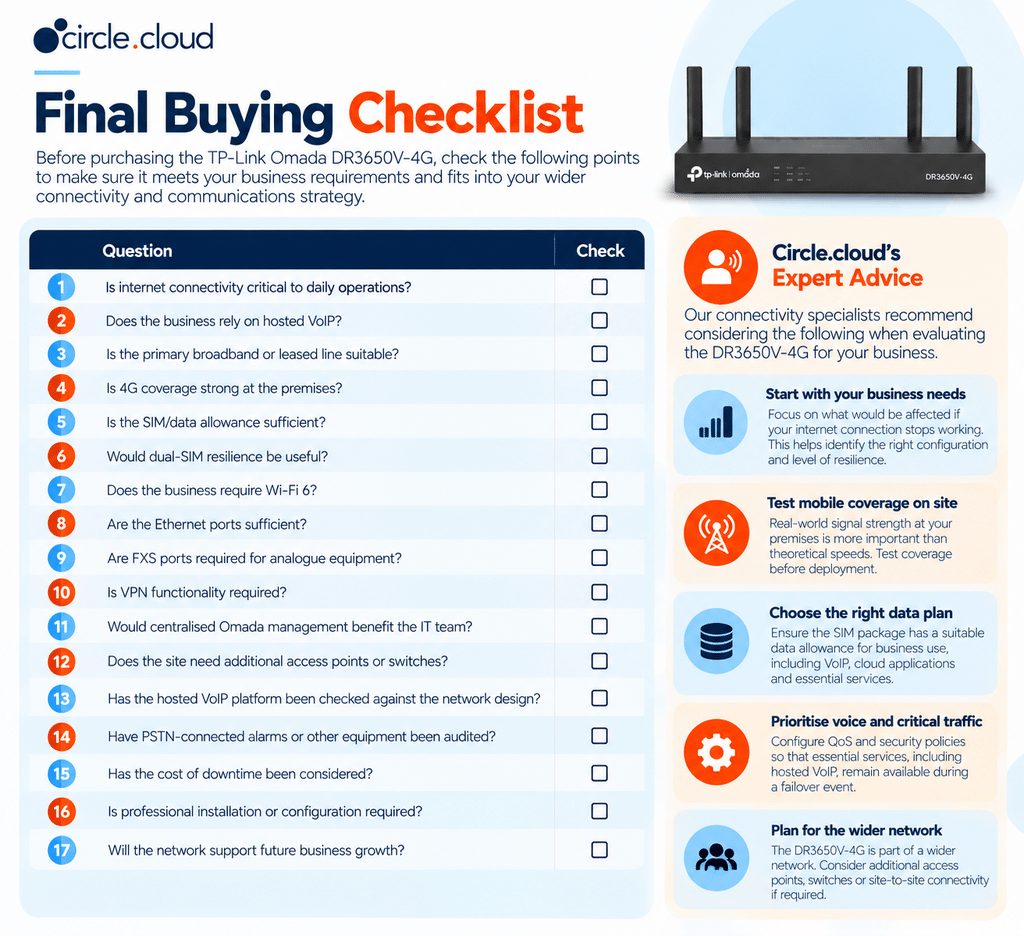
The DR3650V-4G is a capable device, but it should not be purchased in isolation. First, confirm the primary connectivity service. If the business has full-fibre Ethernet connectivity, check that the WAN design and handoff are compatible. If DSL is still being used, verify the service type and expected performance. Next, check mobile coverage at the exact premises. A backup connection is only useful if the router can establish a reliable mobile connection. Then consider data usage. During a long broadband outage, the 4G connection may carry VoIP, cloud applications, email, remote access and other business traffic. The SIM package should therefore have a suitable data allowance and usage policy.
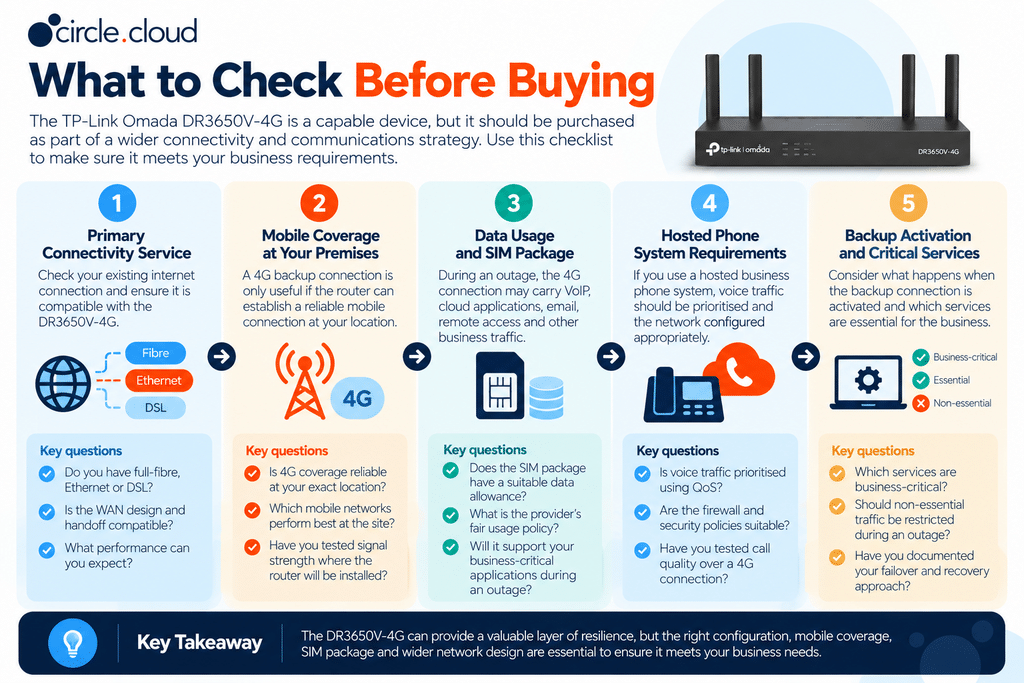
The hosted phone system should also be considered. Voice traffic should be prioritised appropriately, and the network should be configured with suitable QoS and security policies where required. Finally, consider what happens when the backup connection is activated. Decide which services are business-critical and whether non-essential traffic should be restricted during an outage.
Common Buying Mistakes
Avoiding a few common pitfalls helps keep the network resilient and saves costly rework later. Here are the most critical mistakes to watch out for:
- Choosing on Wi-Fi speed alone: AX3000 is an attractive specification, but a business router should be assessed primarily around connectivity, resilience, security and management.
- Assuming 4G failover means zero disruption: Failover reduces downtime. It does not guarantee that existing active sessions will survive a WAN transition.
- Ignoring mobile coverage: A 4G backup router installed in an area with poor mobile reception may not provide the resilience the business expects.
- Treating the router as the entire phone system: The DR3650V-4G supports VoIP connectivity, but the complete business telephone environment also requires the appropriate hosted phone platform, numbers, endpoints and network configuration.
- Using one connectivity provider for everything: Where resilience is critical, businesses should consider whether the primary broadband and mobile backup ultimately depend on sufficiently independent infrastructure.
- Forgetting connected analogue equipment: PSTN migration affects more than conventional telephones. Businesses should audit alarms, payment terminals, lift systems, door entry and other analogue-connected equipment before migration. Openreach specifically advises businesses to identify analogue-connected equipment as part of the move to digital services.
Is the TP-Link Omada DR3650V-4G Right for Your Business?
The DR3650V-4G makes the most sense when connectivity is commercially important and the organisation wants more resilience than a standard single-WAN router provides. It is particularly relevant to businesses where telephone communication, cloud systems and internet access directly support revenue, from care homes and dental practices to manufacturers, engineering firms, automotive businesses and estate agencies.
It can also suit SMEs and multi-site organisations that want centralised network management without building an unnecessarily complicated infrastructure. It may be less appropriate where a business has very basic connectivity requirements, excellent alternative connectivity already exists, or a larger enterprise network requires more advanced dedicated WAN architecture.
The DR3650V-4G and the UK PSTN Switch-Off
The UK PSTN transition makes the wider connectivity discussion particularly important. BT has confirmed that the traditional PSTN network will close on 31 January 2027, with businesses needing to move relevant services to modern digital alternatives. For a business moving from traditional telephony to hosted VoIP, the telephone service becomes dependent on IP connectivity.
That means the conversation should not simply be: “What replaces our old phone system?”
It should be: “What connectivity, telephony and resilience does our business need once voice becomes an internet-based service?”
The DR3650V-4G can form part of that answer, particularly where 4G failover is appropriate. It is not, however, a replacement for every PSTN-connected service. Alarms, lifts, payment terminals, telecare and other connected equipment need to be assessed with the relevant equipment provider before migration.
Why Get the DR3650V-4G from circle.cloud?
The value of a business router depends heavily on how well it fits the wider communications environment. Rather than buying hardware in isolation and working out the phone system and failover later, you can source the DR3650V-4G from circle.cloud and design your connectivity and communications strategy together. Why choose circle.cloud for the DR3650V-4G:
- Complete, end-to-end ecosystem: Spans hosted VoIP phone systems, business broadband, leased lines, unified communications, and managed telecom infrastructure.
- Integrated connectivity & resilience: Combines primary internet access, automated 4G backup routing, and cloud telephony into a single unified architecture.
- Streamlined management: Where circle.cloud supplies the hardware, voice service and internet line, there is one supplier to deal with rather than three.
- UK-based technical support: Direct access to UK-based support teams who understand the router, the connectivity and the hosted phone system as one environment.
For telephone-dependent businesses, each part has a job: the router handles the network layer, broadband carries the primary traffic, 4G provides the backup route and the hosted platform delivers the calls. Bringing these components under one roof creates a more resilient communications foundation with a single point of accountability.
Ready to reduce downtime and simplify your telecoms? Speak to the experts at circle.cloud today to tailor a complete DR3650V-4G connectivity and voice package built for your business.
Final Verdict: What Should Buyers Take Away?
The TP-Link Omada DR3650V-4G should be viewed as more than a conventional Wi-Fi router. Its combination of Ethernet and DSL connectivity, integrated 4G+ Cat6, dual Nano-SIM support, Wi-Fi 6, VPN functionality, VoIP support and centralised Omada management makes it a flexible business gateway for organisations that need reliable connectivity and a practical backup strategy. For a telephone-dependent business, the most important consideration is not simply how fast the router can connect to the internet. It is how the complete connectivity environment behaves when something goes wrong.
If your business relies on customer calls, cloud applications, online systems and consistent communication, resilience should form part of the network design from the outset. For businesses moving towards hosted telephony ahead of the UK PSTN retirement, the DR3650V-4G can form one part of a future-ready communications environment alongside business broadband or a leased line, hosted VoIP, managed networking and appropriate technical support.
If you are unsure whether the TP-Link Omada DR3650V-4G is suitable for your premises, speak to the circle.cloud team. We can look at the wider connectivity and phone system rather than treating the router as a standalone purchase.
FAQs
1. What is the TP-Link Omada DR3650V-4G?
The TP-Link Omada DR3650V-4G is a business gateway that combines Ethernet, DSL and 4G connectivity with Wi-Fi 6, VPN, VoIP and centralised Omada management.
2. Does the DR3650V-4G support 4G failover?
Yes. It has two Nano-SIM slots and can use 4G/LTE as a backup connection when the primary internet service becomes unavailable.
3. Does the DR3650V-4G support dual SIM?
Yes. Dual Nano-SIM support gives businesses additional flexibility when selecting mobile networks and planning connectivity resilience.
4. Can the DR3650V-4G support a hosted phone system?
Yes. It provides the network connectivity that IP handsets and softphones need to reach a hosted business phone system, provided the wider network is correctly configured for voice traffic. Its built-in VoIP function serves the two FXS analogue ports and should be checked for compatibility with the hosted platform before use.
5. Will 4G failover keep an active phone call connected?
Not necessarily. When the connection changes from the primary service to 4G, active sessions or calls may drop and need to reconnect.
6. How fast is the DR3650V-4G’s 4G connection?
The router supports 4G+ Cat6 with theoretical speeds of up to 300Mbps, although actual performance depends on network coverage, signal strength, congestion and other local conditions.
7. Does the DR3650V-4G support Wi-Fi 6?
Yes. It provides AX3000 Wi-Fi 6, with up to 2,402Mbps on 5GHz and 574Mbps on 2.4GHz under the specified wireless standards.
8. What types of internet connections can the DR3650V-4G use?
It supports Ethernet WAN, VDSL2/DSL and 4G LTE, allowing businesses to build a connectivity setup around their available services.
9. Does the DR3650V-4G have VPN support?
Yes. It supports several VPN technologies, including IPSec, OpenVPN, WireGuard, GRE and SSL VPN, along with the legacy PPTP and L2TP protocols.
10. Can the DR3650V-4G be centrally managed?
Yes. The router can be managed through the TP-Link Omada ecosystem, providing centralised visibility and management for supported network infrastructure.
11. Is the DR3650V-4G suitable for multi-site businesses?
It can be suitable for multi-site organisations that need consistent connectivity and centralised network management, although the wider network architecture will depend on each site’s requirements.
12. Do I need strong 4G coverage to use the DR3650V-4G?
Yes. 4G failover is only useful if the router can establish a reliable mobile connection. Businesses should test mobile coverage at the actual installation location before deployment.
13. What size of business is the DR3650V-4G suitable for?
Suitability depends more on connectivity requirements than employee count. It can be relevant to SMEs, multi-site organisations and businesses where internet downtime could disrupt important operations.
14. Does the DR3650V-4G replace a hosted business phone system?
No. The router provides connectivity and VoIP-related functionality, but it is not a replacement for a complete hosted business phone platform with numbers, call routing, extensions and communications features.
15. Is the DR3650V-4G suitable for businesses preparing for the PSTN switch-off?
It can form part of a modern connectivity and communications strategy, but businesses should also audit any PSTN-connected equipment such as alarms and other analogue services rather than relying on the router alone.
About the Reviewer & Editorial Methodology
Reviewed By: circle.cloud Technical & Solutions Team
Role: Business Communications and Network Infrastructure Specialists
Experience: Supporting UK organisations with hosted VoIP, business broadband, leased lines, cloud communications and business network infrastructure.
Editorial Methodology
This buyer’s guide has been created using a combination of:
- Current TP-Link Omada DR3650V-4G product specifications and manufacturer documentation.
- Practical business connectivity and network infrastructure considerations.
- 4G failover, broadband resilience and hosted VoIP deployment principles.
- Assessment of connectivity options, scalability, resilience, management and business suitability.
- Consideration of UK organisations transitioning away from legacy PSTN infrastructure.
- Evaluation of how the DR3650V-4G can fit into wider business communications and network environments.
The product-specific specifications in this guide have been checked against current TP-Link Omada product information.
Editorial Policy
circle.cloud aims to provide practical buying guidance to help UK businesses make informed technology decisions. circle.cloud supplies the DR3650V-4G alongside its connectivity and hosted telephony services, and this guide is written with that in mind. Recommendations consider the wider business environment rather than focusing solely on individual product specifications, with particular attention to reliable connectivity, practical deployment and modern communications infrastructure.
Disclaimer
Product specifications, firmware capabilities, network compatibility and supported features can change. Businesses should confirm the latest manufacturer specifications and compatibility requirements before purchase. 4G performance depends on mobile network coverage, signal strength, network congestion and the selected SIM/data plan. Failover does not guarantee uninterrupted continuation of active sessions or phone calls. A professional assessment may be appropriate for business-critical or multi-site deployments.