For many businesses, connectivity is no longer just about providing WiFi access. It is about maintaining reliable performance across dozens, sometimes hundreds, of devices all competing for bandwidth at the same time.
Whether that means supporting a busy office with hybrid workers, delivering guest WiFi in a hospitality environment, or keeping point-of-sale (POS) systems and handheld devices connected in a retail space, modern networks face constant demand from every direction.
This is where WiFi 6 access points come into play.
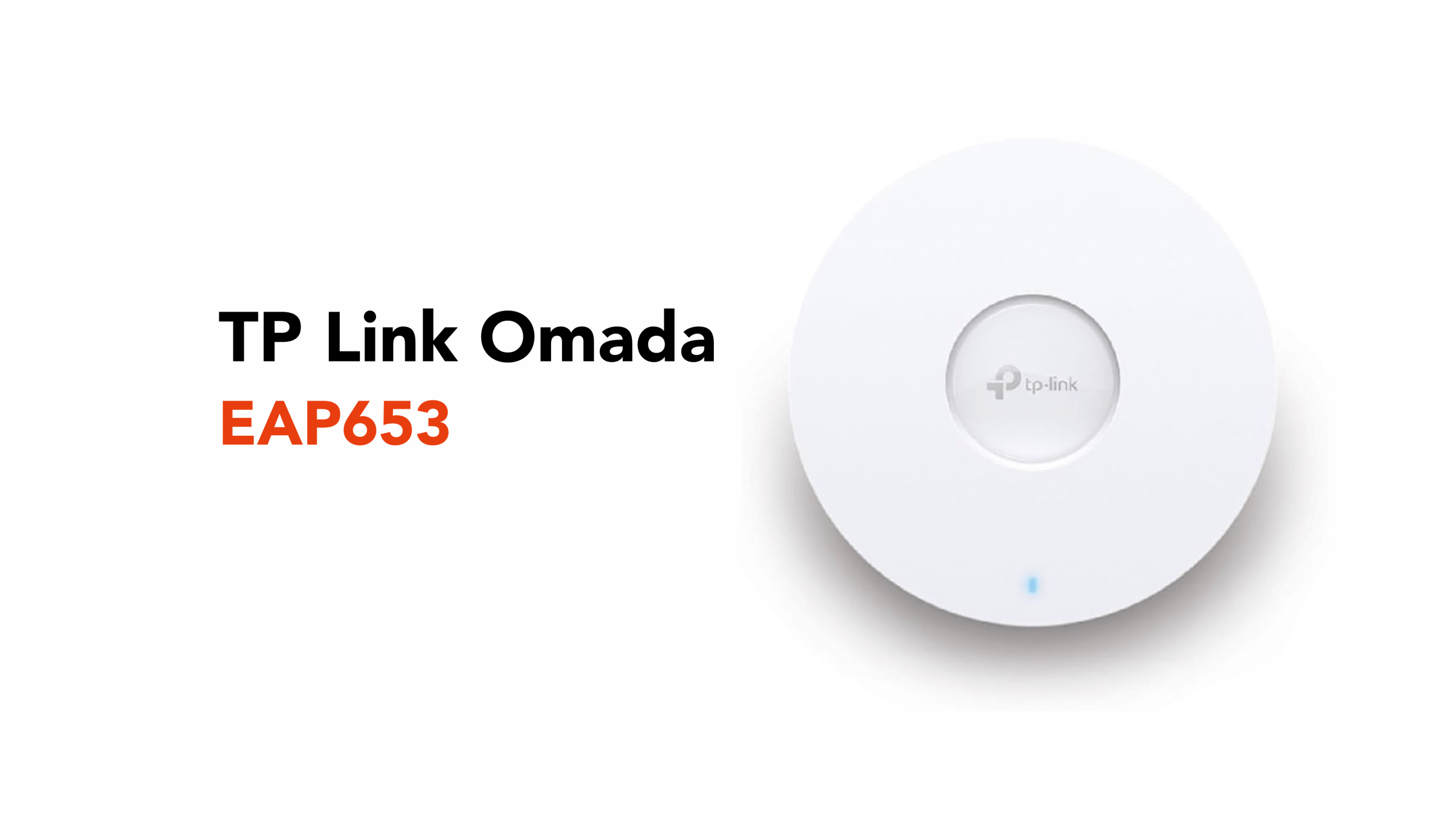
The TP-Link Omada EAP653 is built to handle these high-density environments, delivering faster speeds, improved efficiency, and more stable connections across business networks.
For organisations upgrading from older WiFi standards or expanding their infrastructure, it is a practical piece of networking equipment with a clear role: delivering consistent wireless performance in environments where traditional WiFi begins to struggle.
Before diving into features and use cases, it is worth understanding the role this type of access point plays in a network.
What Is the TP-Link Omada EAP653?
The TP-Link Omada EAP653 is not a consumer-grade router designed for a single household.
Instead, it is a business-class, ceiling-mounted WiFi 6 access point built to provide reliable wireless coverage across offices, commercial spaces, and multi-device environments.
Its role is to extend and distribute wireless connectivity as part of a wider network, often working alongside switches, gateways, and additional access points.
At its core, the EAP653 is designed for:
High-Density Connectivity
The EAP653 is designed specifically for supporting multiple devices at once.
In most business environments, it is common for each user to have multiple connected devices, which can include:
- Laptops,
- Smartphones,
- Voice over Internet Protocol (VoIP) handset,
- And Internet of Things (IoT) equipment all compete for bandwidth.
The EAP653 is built to handle this demand and can support 250 or more concurrent devices while maintaining stable performance.
Instead of devices competing for airtime, the EAP653 access point manages traffic more efficiently, reducing network congestion.
WiFi 6 Efficiency
WiFi 6 introduces several technologies that improve how data is transmitted across the network.
Rather than simply increasing speed, it focuses on efficiency and stability.
A few other technologies are doing the heavy lifting here in the background, which include:
- OFDMA (Orthogonal Frequency Division Multiple Access) allows multiple devices to transmit data at the same time
- MU-MIMO (Multi-User, Multiple Input, Multiple Output) enables the access point to transmit data to multiple devices simultaneously.
- 1024-QAM (1024-Quadrature Amplitude Modulation), which increases the amount of data carried in each transmission.
Together, these features help reduce latency, improve responsiveness, and maintain stable performance under load.
What Is a WiFi 6 Access Point?
A WiFi 6 access point solves a specific problem: how to deliver fast, reliable wireless connectivity to many devices simultaneously without performance dropping off.
Home or traditional WiFi networks can become congested as more devices connect, leading to slower speeds, dropped connections, and inconsistent performance.
A WiFi 6 access point improves this by more effectively managing how devices share the network.
Instead of acting as a simple signal broadcaster, the access point becomes a traffic controller, ensuring data moves efficiently between devices and the network.
Now that we understand what the EAP653 is, let’s look at its key features.
Key Features of the TP-Link Omada EAP653
The TP-Link Omada EAP653 is designed to deliver reliable wireless performance in business environments where consistency matters.
Its features set focuses on speed, efficiency, and scalability.
These key features include:
AX3000 Dual-Band WiFi 6 Performance
The EAP653 delivers combined wireless speeds of up to 2976 megabits per second (Mbps), with 2402 Mbps on the 5 gigahertz (GHz) band and 574 Mbps on the 2.4 GHz band.
This provides the capacity needed to support high-bandwidth applications such as video conferencing, cloud services, and large file transfers.
While real-world performance depends on network design and environmental factors, the available throughput supports demanding business use cases.
Designed for Ceiling or Wall Mount Deployment
The EAP653 is a ceiling or wall-mounted wireless access point, designed to deliver consistent coverage across indoor business environments.
Its low-profile form factor allows it to blend into offices, retail spaces, and hospitality environments, while its positioning helps optimise signal distribution across open areas.
Coverage and Range Considerations
Unlike long-range outdoor bridging devices, the EAP653 is designed for indoor coverage rather than distance.
In typical deployments, this means:
- Consistent coverage across offices, meeting rooms, and open-plan spaces
- Multiple access points are used together for larger environments
- And strategic placement to eliminate dead zones and maintain performance
The actual WiFi coverage will depend on layout, walls, interference, and client density, which is why proper network design is key.
High Client Capacity
The EAP653 is designed to support a high-density capacity of up to 250+ devices.
This allows businesses to scale their networks without immediate performance limitations as the number of devices grows.
It also ensures more consistent connectivity in busy environments.
Seamless Roaming for Continuous Connectivity
The EAP653 supports seamless roaming between access points.
This allows users to move through a building without losing connection or experiencing interruptions.
As modern teams move between devices and locations, connectivity needs to follow them without interruption.
In practice, this supports:
- VoIP calls without dropouts
- Stable video meetings
- Continuous connectivity for mobile devices
Omada Mesh Networking
The device supports mesh networking within the Omada ecosystem.
This allows access points to connect wirelessly to one another, extending coverage without requiring additional cabling.
It provides flexibility in environments where running Ethernet is difficult or impractical.
Gigabit Connectivity and Installation Flexibility
The EAP653 includes a Gigabit Ethernet port, ensuring high-speed wired backhaul to the network.
It also supports Power over Ethernet (PoE+), allowing both power and data to be delivered through a single cable. The EAP653 supports standard 802.3at PoE (PoE+), but please note that a DC power adapter is not included in the box for this specific model.
This simplifies installation and enables clean, professional deployments without additional electrical work.
WPA3 Security and Network Segmentation
Security is a core requirement in business networks, with the EAP653 supporting WPA3 encryption, which provides stronger protection for wireless connections.
The EAP653 also supports multiple Service Set Identifiers (SSIDs), allowing businesses to segment networks for different users and devices.
For example:
- Staff network (SSID: Office_Secure) with full internal access
- Guest network (SSID: Company_Guest) with internet-only access
- Devices network (SSID: POS_Devices) for restricted operational systems
Although these networks are broadcast from the same hardware, they operate independently, improving both security and performance.
Omada SDN Centralised Management
The EAP653 integrates with the Omada Software-Defined Networking platform, enabling centralised control of network devices.
This enables administrators to:
- Monitor network performance
- Configure multiple access points from a single interface
- Manage networks across multiple locations
For growing businesses, this provides a scalable way to manage infrastructure without increasing complexity.
Now that we know the EAP653’s main features, let’s review what its real-world business applications could involve.
Real-World Business Use Cases
The EAP653 is built for environments where connectivity needs to remain stable under constant demand.
Typical use cases include:
- Offices supporting hybrid work and multiple devices per user
- Retail environments running POS systems and inventory platforms
- Hospitality venues providing guest WiFi
- Warehouses using connected scanners and operational tools
- Education environments with high device density
In each case, the focus is on maintaining reliable performance as the number of connected devices grows.
Upgrading to WiFi 6 is not just about the hardware; it requires the right design, placement, and configuration to deliver real performance gains.
How circle.cloud Can Help
Deploying business WiFi, such as the TP-Link Omada EAP653, is not just about installing access points. It is about performance that depends on network design, placement, and integration with existing infrastructure.
That is where circle.cloud supports businesses:
- Designing scalable WiFi networks for high-density environments
- Recommending the right access point placement and configuration
- Installing and configuring Omada-based networks
- Integrating wireless infrastructure with switching, routing, and VoIP systems
- Providing ongoing support and network management
Whether you are upgrading an existing network or building one from the ground up, the right setup ensures the hardware performs as intended.
Contact circle.cloud to discuss your requirements or to get help designing a business WiFi solution tailored to your environment.