Business WiFi is one of the most critical pieces of infrastructure in any organisation.
It is no longer just about connecting to the internet. It is about delivering consistent performance across dozens or even hundreds of devices, all competing for bandwidth at the same time.
Your network needs to support video calls, cloud applications, guest access, payment systems, and IoT devices, all running simultaneously without slowing each other down.
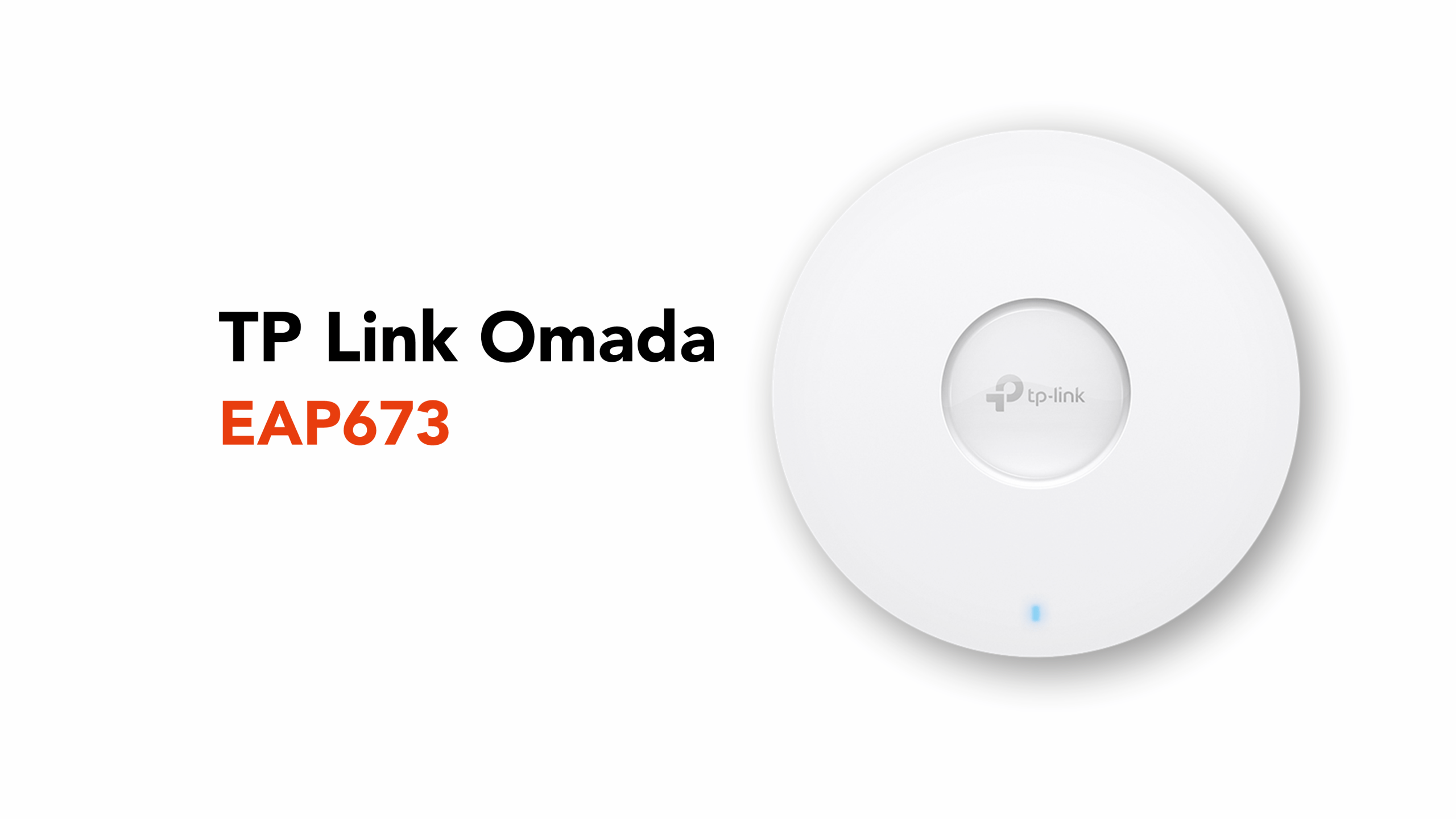
This is exactly where the TP-Link Omada EAP673 steps in.
It is not trying to be flashy. It is designed to be dependable, scalable, and fast in environments where older WiFi starts to struggle under pressure.
What is the TP-Link Omada EAP673?
The EAP673 is a ceiling-mounted, dual-band WiFi 6 access point built for business environments that need reliable, high-capacity wireless coverage.
It forms part of TP-Link’s Omada ecosystem, meaning it is designed to work as part of a centrally managed network rather than operating as a standalone device.
Think of it as one piece of a larger system, working alongside switches, routers, and controllers to deliver consistent connectivity across an entire site or multiple locations.
What is WiFi 6 and What Does AX5400 Actually Mean?
WiFi 6, also known as 802.11ax, is the latest widely adopted wireless standard designed to handle modern network demand.
At a surface level, it is faster. But the real story is how it performs when multiple devices are connected simultaneously.
Understanding WiFi 6 Speed
WiFi 6 significantly increases theoretical throughput compared to previous generations:
- WiFi 5 (802.11ac): up to ~3.5 Gigabits per second (*Gbps)
- WiFi 6 (802.11ax): offers a maximum theoretical throughput of 9.6 Gbps across all bands, nearly triple the capacity of WiFi 5
(*Gbps stands for Gigabits per second, a measure of how much data can move across a network each second.)
That does not mean every device suddenly reaches those speeds. What it does mean is that your network has far more total capacity to share across users.
Where AX5400 Fits In
The TP-Link Omada EAP673 is rated at AX5400, which reflects its combined wireless capacity:
- Up to 4804 Mbps on 5 Gigahertz (GHz)
- Up to 574 Mbps on 2.4 GHz
This combined throughput provides businesses with the headroom needed to support modern workloads without congestion, especially in environments where dozens of devices are active simultaneously.
In most business environments, WiFi performance is not limited by a single device. It is limited by the number of devices competing for bandwidth. WiFi 6 improves this by enabling the network to communicate with multiple devices simultaneously, rather than serving them one by one.
Technologies like:
- OFDMA improves efficiency by letting devices share channels
- MU-MIMO enables simultaneous communication with multiple users
- 1024-QAM increases data density for faster transmission
The result is:
- Faster speeds during busy periods
- Lower latency for calls and cloud apps
- More stable connections across high-density environments
Consistency Over Peak Speed
Even if your internet connection stays the same, WiFi 6 can still feel like a major upgrade.
That is because:
- Congestion is reduced
- Bandwidth is used more efficiently
- Devices spend less time waiting to send or receive data
So while peak speeds increase, the real advantage of WiFi 6 is not just raw speed.
It has consistent, reliable performance under load.
Built for High-Density Environments
The EAP673 is designed for environments where WiFi demand builds quickly and stays high throughout the day:
- Offices with hybrid workers
- Retail stores running POS systems alongside guest networks
- Hospitality venues with dozens of connected devices per room
- Schools, clinics, and shared workspaces
It can support 250+ concurrent devices, making it well-suited to spaces where network load is constant rather than occasional.
In these environments, performance is not about peak speed. It is about maintaining consistent connectivity across every device on the network.
The EAP673 is built to keep critical systems, user devices, and guest access running smoothly simultaneously, without performance dropping as more devices come online.
The 2.5GbE Advantage
One of the standout features of the EAP673 is its 2.5 Gigabit Ethernet (2.5GbE) port.
In a WiFi 6 environment, this matters more than it might seem.
Traditional access points rely on standard 1 Gigabit Ethernet (1GbE) ports. While that worked for older WiFi standards, it can quickly become a bottleneck when handling higher wireless throughput.
Removing the Bottleneck
The 2.5GbE port increases wired capacity to 2.5 Gigabits per second, allowing the access point to deliver more of its wireless performance without restriction.
This is especially important when:
- Multiple high-speed devices are connected
- Large files are being transferred
- Cloud apps and video calls are running simultaneously
Better Performance in Multi-AP Environments
In larger deployments, where multiple access points are connected to the same network, uplink capacity plays a key role.
A 2.5GbE connection helps:
- Reduce congestion between access points and the network
- Improve load balancing across users
- Maintain consistent speeds as demand increases
Future-Ready Without a Full Overhaul
2.5GbE can operate over existing Cat5e cabling at distances up to 100 meters, providing a cost-effective path to 2.5 Gbps speeds without re-cabling.
It offers a practical middle ground:
- Faster than Gigabit
- Simpler and more cost-effective than 10GbE
Power and Simplicity with PoE+
The EAP673 also supports Power over Ethernet (PoE+), delivering both power and data through a single cable.
This simplifies installation by:
- Reducing the need for additional power points
- Allowing flexible placement
- Streamlining multi-device deployments
Centralised Management with Omada SDN
The EAP673 integrates with Omada Software-Defined Networking (SDN), allowing businesses to manage their entire network from a single interface.
This includes:
- Centralised cloud or local management
- Zero-touch provisioning (ZTP)
- Real-time monitoring and analytics
- Remote troubleshooting
You can manage multiple sites, devices, and users without physically interacting with each access point.
For growing businesses, this is the difference between scaling smoothly and constantly reacting to issues.
Smooth Coverage Across Your Entire Space
Speed is only part of the story. What matters just as much is how your connection holds up as people move around.
The EAP673 is built to keep things seamless.
It supports:
- Seamless roaming, so devices switch between access points without dropping connection
- Omada Mesh makes it easier to extend coverage without running cables everywhere
In practice, this means:
You can move between rooms, floors, or large spaces without interruptions. No dropped calls, reconnecting, or sudden slowdowns.
This is especially useful in:
- Multi-floor offices
- Warehouses and large workspaces
- Hotels, retail stores, and open-plan environments
Put simply, people move. Your WiFi should keep up.
Installation and Deployment
The EAP673 is designed for flexible deployment:
- Ceiling or wall mounting
- Powered via PoE+ or DC supply
(Note: The EAP673 requires 802.3at PoE+ (Power over Ethernet) to operate at full performance. A DC power adapter is typically not included in the box)
PoE simplifies installation by allowing both power and data through a single cable.
For businesses expanding or upgrading their network, this reduces complexity and speeds up deployment.
Security and Network Control
Security is built into the platform, not added as an afterthought.
Key features include:
- WPA3 encryption for stronger wireless security
- VLAN support for network segmentation
- Guest network isolation
- Captive portal authentication
- Rogue access point detection
This allows businesses to separate traffic and maintain control without sacrificing performance.
When Should You Choose the EAP673?
The EAP673 is a strong fit if:
- Your current WiFi struggles with multiple users or devices
- You are upgrading from WiFi 5 or entry-level WiFi 6
- You need centralised network management
- Your business relies on stable, always-on connectivity
If your network is growing, this is the kind of access point that grows with it.
The TP-Link Omada EAP673 does not try to reinvent business WiFi.
It does something more valuable.
It delivers the speed, stability, scalability, and control that modern networks actually need, without unnecessary complexity.
For businesses that rely on connectivity every day, that kind of reliability is not a luxury.
It is infrastructure.
Need Help Designing Your Network?
Choosing the right access point is only part of the puzzle.
The real performance comes from how everything works together.
- Network design and planning
- Omada deployments
- Multi-site connectivity
- Business-grade WiFi optimisation