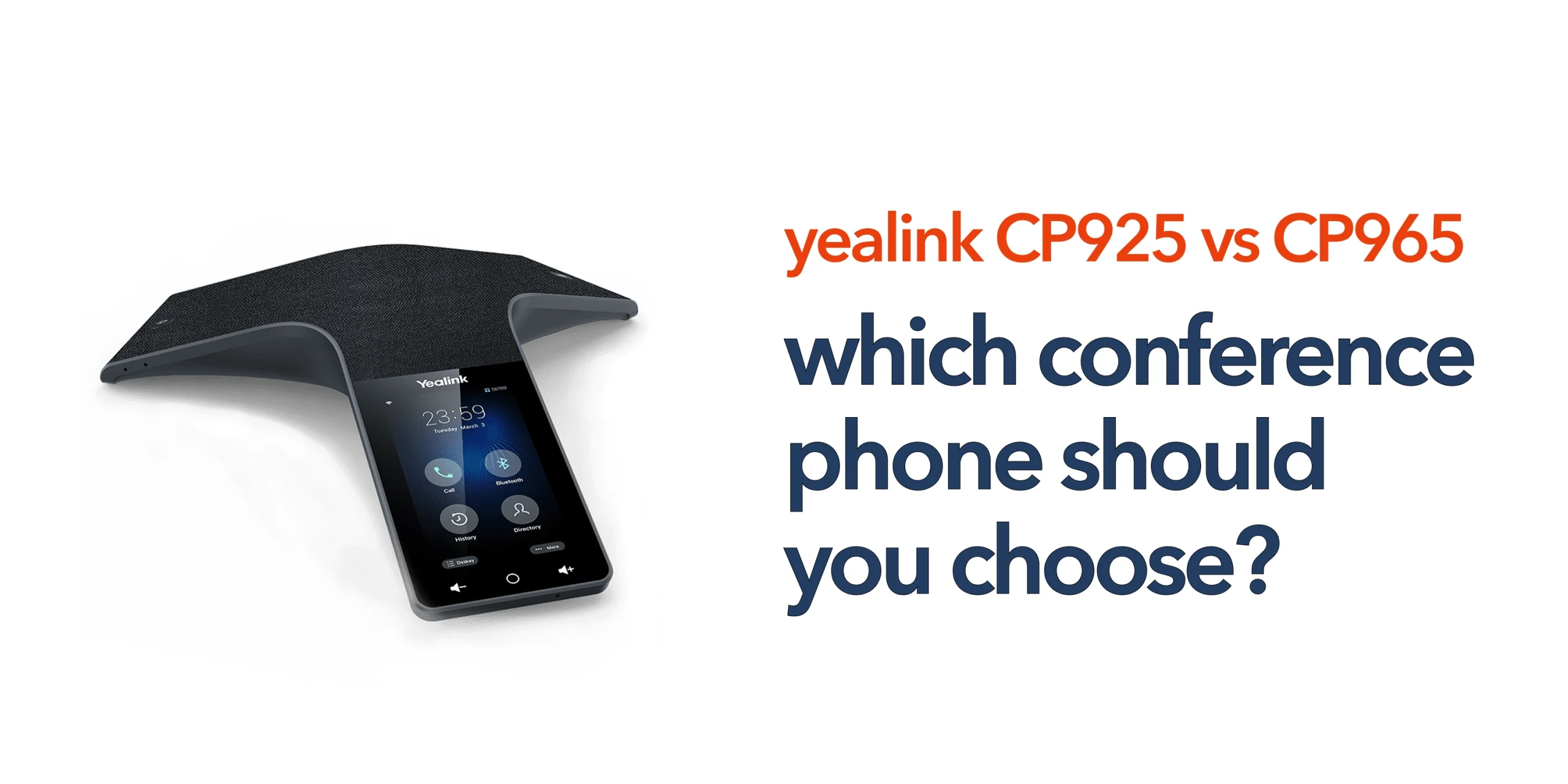
Many businesses upgrading to VoIP focus on the platform itself but overlook the importance of meeting room hardware. In practice, the conference phone plays a direct role in how effectively your team communicates. Poor audio quality, inconsistent voice pickup, or a difficult interface can quickly disrupt meetings and reduce productivity. When comparing Yealink CP925 vs CP965, the difference goes beyond specifications. It comes down to how your meeting spaces are used, how many people are typically involved, and how critical clear, reliable audio is to your day-to-day operations. A small meeting room has very different requirements compared to a large boardroom or client-facing space.
Both devices are built for modern conference environments and integrate with cloud-based VoIP phone systems, supporting the move away from legacy infrastructure such as PSTN. However, they are designed for different levels of demand. The CP925 is suited to smaller, straightforward meeting setups, while the CP965 is built to handle larger spaces and more demanding collaboration needs.
Choosing the right device ensures your meetings run smoothly, your teams stay productive, and your communication technology supports your business rather than holding it back.
Interest: Overview of Yealink CP925 and CP965
The Yealink CP925 and CP965 are professional conference phones built for Voice over Internet Protocol (VoIP) environments and unified communications. They integrate with cloud telephony platforms, allowing businesses to manage meetings, calls, and collaboration through a central system while moving away from legacy PSTN infrastructure. At a high level:
- Yealink CP925 is designed for small to medium meeting rooms with straightforward requirements
- Yealink CP965 is a premium conference phone built for larger rooms and higher audio performance demands
Both support HD voice, multiple connectivity options, and integration with modern business phone systems.
Key Differences Between Yealink CP925 vs CP965
Understanding the differences between the Yealink CP925 and CP965 helps ensure you choose the right conference phone for your meeting environment. While both devices support modern VoIP communication, they are designed for different room sizes, usage levels, and performance expectations.
Design and Build Quality
The CP925 features a compact and practical design, making it well-suited to smaller meeting rooms and standard office environments. It is easy to position on a table and straightforward to deploy without requiring a complex setup.
The CP965 takes a more premium approach, with a larger footprint and higher-end materials. It is designed for more demanding environments such as boardrooms or executive spaces, where both performance and presentation matter.
Audio Quality and Microphone Performance
Audio performance is one of the most important differences between these two models.
The CP925 delivers reliable HD audio that works well for everyday meetings in smaller rooms. It provides clear voice transmission for teams with limited participants and straightforward communication needs.
The CP965 offers a more advanced audio experience, with enhanced microphone arrays and intelligent noise reduction. It is designed to capture voices clearly across larger spaces, ensuring that all participants can be heard without repetition or disruption. This makes it a stronger choice for collaborative or client-facing environments.
Room Size and Coverage
The CP925 is best suited to small and medium meeting rooms where participants are seated close to the device. In these environments, it provides consistent and dependable performance.
The CP965 is built for medium to large rooms, where voice pickup across a wider area is essential. Its extended coverage ensures that communication remains clear even when participants are spread out.
Selecting the right device for the room size is critical. Using a device that is not suited to the space can result in poor audio quality and a frustrating meeting experience.
User Interface and Experience
The CP925 offers a simple and intuitive interface that allows teams to use the device without training. It is designed for quick access to core features, making it practical for everyday meetings.
The CP965 includes a larger touchscreen and a more advanced interface, providing improved navigation and greater control over call handling. This is particularly useful in environments where meetings are frequent or involve more complex communication needs.
H3: Price and Positioning
The CP925 is positioned as a cost-effective option, making it ideal for businesses equipping multiple meeting rooms without significantly increasing costs.
The CP965 sits at a higher price point but delivers enhanced performance, particularly in larger rooms or more demanding environments. For businesses that rely on high-quality meetings, the additional investment can provide long-term value.
Overall, the choice between Yealink CP925 vs CP965 is less about basic functionality and more about aligning the device with your meeting space, usage patterns, and expectations for audio quality.
Which Conference Phone Fits Your Business?
Choosing the right conference phone depends on how your meeting spaces are used and what level of performance your team expects. Room size, number of participants, and the importance of audio clarity all play a role in making the right decision. Aligning the device with your environment ensures consistent communication and avoids unnecessary limitations.
- Small Meeting Rooms and Huddle Spaces: For smaller meeting rooms or huddle spaces, the CP925 is usually more than sufficient. It provides reliable audio and simple usability without adding unnecessary complexity, making it ideal for everyday internal meetings.
- Medium to Large Meeting Rooms: For larger rooms where multiple participants need to be heard clearly, the CP965 is the better choice. Its enhanced microphone coverage ensures consistent communication across the space, reducing the need for repetition or raised voices.
- Executive and Client-Facing Environments: In environments where presentation and audio quality are critical, such as boardrooms or client-facing meeting spaces, the CP965 offers a more professional and reliable experience, helping maintain clear and effective communication.
How Conference Phones Fit Into Modern Business Telecoms
Conference phones are only one part of a wider communication system. To deliver consistent performance, they need to work alongside reliable business broadband, a cloud-based business phone system, and properly configured call routing and user setup, all supported by a provider that ensures everything integrates effectively.
Many audio or connectivity issues are not caused by the device itself, but by network limitations or poor configuration. As UK businesses continue transitioning from the public switched telephone network (PSTN) to cloud-based systems, aligning your meeting room technology with your wider infrastructure is essential for reliable and effective communication.
Making the Right Decision
Choosing between Yealink CP925 vs CP965 depends on how your business uses its meeting spaces. If your meetings are small, straightforward, and cost-sensitive, the CP925 is a practical choice. For larger rooms, higher-quality collaboration, or client-facing communication, the CP965 offers a clear advantage. The most effective approach is to match the device to the room and its purpose rather than applying a one-size-fits-all solution. With the right setup, your conference technology becomes a reliable part of your wider communication system.
If you are reviewing your meeting rooms or upgrading your telecoms, circle.cloud can help ensure your devices, network, and cloud phone system work together from the start.
FAQs
What is the main difference between Yealink CP925 vs CP965?
The main difference is audio performance and room coverage. The CP965 is designed for larger spaces and delivers more advanced audio capabilities.
Which conference phone is better for small businesses?
The CP925 is often better for small businesses due to its cost-effectiveness and suitability for smaller meeting rooms.
Can both devices be used with VoIP systems?
Yes. Both are designed to integrate with modern VoIP and cloud telephony platforms.
Is the CP965 worth the higher cost?
For businesses that rely on high-quality meetings or larger rooms, the improved audio and coverage can justify the investment.